
Cardiologist salary report: What’s a cardiologist earning in 2026?
August 24, 2026
Cardiologists averaged $575,000 in total compensation in 2025, according to Medscape’s 2026 Cardiologist Compensation Report. This figure is up 10% from the year before and is the fastest pay growth of any specialty Medscape tracked this year. Ask cardiologists how that pay actually feels day to day, though, and the picture gets more complicated: Just over half (52%) say they personally feel fairly paid, and nearly two-thirds (61%) think the medical profession as a whole is underpaid.
How much does a cardiologist earn in 2026?
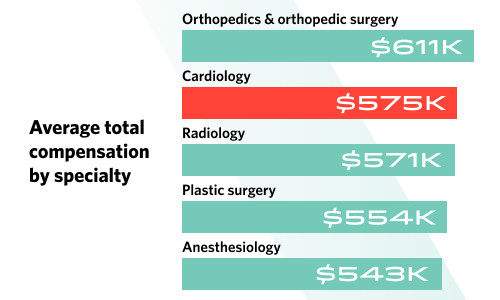
Cardiology’s $575,000 average salary lands it second only to orthopedics ($611,000) among the more than two dozen specialties Medscape surveyed, just ahead of radiology ($571,000). A meaningful share of that pay comes with strings attached: 74% of cardiologists qualify for an incentive bonus, averaging $79,000, and the single biggest factor in calculating it, cited by 76% of respondents, is RVUs generated. In other words, cardiologists’ compensation is often tied to a productivity metric.

It’s also worth noting where that productivity pressure is heading. This year, 57% of cardiologists said RVUs and similar metrics now directly influence their base salary, not just an incentive bonus on top of it, up from 47% the year before. That means more of a cardiologist’s guaranteed pay is now tied to volume-based metrics over which an individual physician has limited control.
What’s the average income for a cardiologist compared to other specialties?
Cardiology was the second-highest-paid specialty in 2025. Additionally, it’s one of only three specialties, alongside radiology and anesthesiology, that ranked in the top five for both total pay and pay growth that year, and cardiology’s 10% year-over-year increase was the highest of any specialty Medscape tracked. That combination—high pay that’s still climbing quickly—is a big part of why cardiology compensation keeps making headlines.
Only half of cardiologists feel fairly compensated
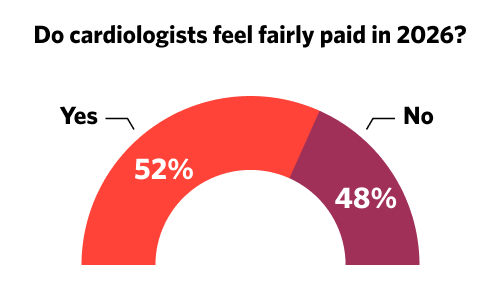
Though cardiology pay is increasing, the sense of being fairly compensated isn’t. Only 52% of cardiologists say they personally feel fairly paid, even as the average paycheck grew 10% in a single year. And when Medscape asked about negotiating power, the numbers told a similar story: 64% of cardiologists say they never got more than “moderately” aggressive when negotiating their last contract, and a meaningful share had no real opportunity to negotiate at all.
Put those two data points together, and a pattern starts to form. It’s not that cardiologists' pay is bad. It’s that a growing number of cardiologists don’t feel they have much say in it, whether that means negotiating a raise or the conditions attached to the paycheck.
There’s a third data point worth adding to the picture: When Medscape asked cardiologists how well their paycheck covers their family’s actual living expenses, debts, and retirement savings, only 31% said it covers more than they need. Forty-two percent said it matches what they need, and 27% said it falls short. A strong national average doesn’t automatically translate into a strong personal financial position, which is why a growing number of cardiologists are exploring other ways to continue work on their terms.
Many cardiologists are already earning extra income
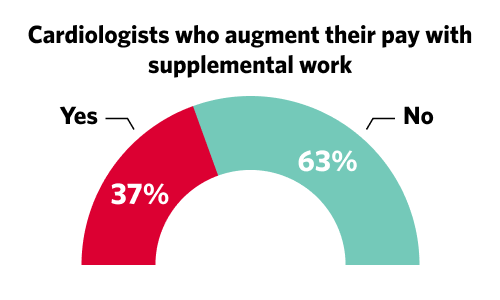
According to Medscape, 37% of cardiologists already augment their regular pay with outside work—whether that’s picking up more clinical hours, working locum tenens, or doing nonmedical work—up from 27% the year before. Locum tenens isn’t necessarily an alternative to full-time employment. For a growing share of cardiologists, it’s simply the most structured, credentialed version of something a third of the field is already doing.
What is locum tenens? A beginner’s guide
What locum tenens cardiologists actually earn
Locum tenens cardiologist pay currently ranges from $250 to $350 an hour, according to Locumstory, up from $275 to $300 an hour the year before.
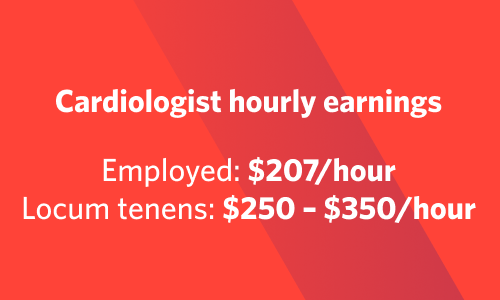
For comparison, employed cardiologists average $207.93 an hour, according to the Bureau of Labor Statistics’ Occupational Employment and Wage Statistics. The two figures aren’t a perfect apples-to-apples comparison: BLS wages reflect W-2 employment excluding self-employed physicians, while locum rates reflect 1099 assignment work, which typically comes without employer-paid benefits built into the rate.
That range reflects hours actually worked on assignments, not a projected annual salary, since locum schedules are typically structured by assignment length rather than by continuous, full-year employment, as is the case with an employed cardiologist’s average of $575,000.
Assignment length tends to vary by subspecialty. Per Locumstory’s pay-trends data, shorter seven- to eight-day contracts are standard for invasive cardiology, while noninvasive roles can extend from three months to a year. That range matters when you’re weighing locum tenens against a full-time role; a longer assignment behaves more like a temporary job, while a short one is closer to picking up an extra shift.
Interested in locums? Here’s why cardiologists enjoy it
Cardiologist locum tenens pay by career stage
How locum tenens fits into a cardiologist’s finances varies depending on where they are in their career.
Early career: Exploring options while paying off debt
Early-career cardiologists face distinct pressures. Years of medical school and fellowship training typically come with six figures of debt, and that bill starts coming due at exactly the moment a physician has the least negotiating leverage: a first contract, often with a non-compete attached, that can lock them into one practice setting, one employer, and sometimes one geographic market for years. Committing to the wrong first job or getting boxed out of a local market by a restrictive non-compete can set an early career back in ways that are hard to undo.
Locum tenens gives early-career cardiologists a lower-stakes way to navigate all of that. Rather than committing to a single practice setting right out of fellowship, locums lets a physician test different hospitals, regions, and patient populations before signing a long-term contract. It also puts income toward student loan and fellowship debt right away. And for a physician who does run into a restrictive non-compete, locum tenens offers a way to keep practicing and earning in the meantime, rather than sitting out a contract dispute unpaid.
Mid-career: Finding financial and clinical autonomy
Mid-career cardiologists experience different challenges. They have been employed long enough to have developed their skills, but they may feel boxed in by inflexible schedules and call requirements. They may have started a family and want to spend more time with their loved ones. Conversely, unexpected career upheaval may lead to difficult choices after years of stability.
Dr. Gregory Kloehn, an interventional cardiologist, turned to locum tenens after the hospital where he worked abruptly closed, and again after being furloughed during the pandemic. “Locums was a good intermediary,” he says. “I could go and work in places and give good care to people where it was needed.” He also appreciated locums for the time it gave him to look for the next right full-time opportunity.

Locums gives you a chance to breathe, to buy time. You have income coming in, and you can go in a methodical search pattern, which I think is the best thing long term.
Late career: Continuing to work on their own terms
Late-career cardiologists often grapple with how to continue practicing without the pace and call burden of a full-time hospital role. A hard stop at retirement can mean walking away from decades of clinical skill overnight, and from the income that goes with it, before a physician is truly ready. Locum tenens lets cardiologists wind down gradually: fewer assignments, more control over their schedule and location, and a way to keep earning on their own terms for as long as they want.
Dr. Joseph Wiedermann turned to Weatherby because he wanted to experience something new, following a non-compete clause at his previous employer. He ended up taking an assignment in Guam, where he helped the hospital put together a cardiology program. After several years there, he predicts he’ll return to the mainland U.S. to be closer to family. And his consultant at Weatherby will be there to help him find work—wherever and whenever he wants.
Is it right for you? The pros and cons of locum tenens
What locums income means for your taxes
Most locum tenens work comes with 1099 independent contractor status rather than a W-2, which opens up financial planning options not available to employed physicians, including higher retirement-contribution limits through a solo 401(k) than a typical hospital 403(b) allows.
That structure cuts both ways. Independent contractor status also means handling your own quarterly estimated taxes and often setting up a business entity, such as an LLC, to manage income and deductions cleanly. None of that is a reason to avoid locum tenens work. It’s simply a different financial framework than the one most employed cardiologists are used to, and one that’s worth understanding, with the right professional guidance, before your first assignment, rather than after.
This is general information, not tax or financial advice. Every physician’s situation is different, so talk with a qualified tax professional or financial planner about what these options could mean for you.
Want more on managing locums income? Read The finances of locum tenens
Do the math for yourself
Curious what locum tenens could actually mean for your bottom line? Click below to find free calculators that estimate your potential locums earnings and show how much faster you could pay off your debt. It only takes a few minutes to see the numbers for yourself.
Ready to see what’s possible?
Whether you’re paying down debt, want to increase your compensation, or just want more control over your schedule without giving up income, locum tenens is worth running the numbers on. Give us a call at 954.343.3050 to speak with a consultant or view today’s cardiology locum tenens opportunities.
Recommended Articles
Categories

Thank you,
We appreciate you contacting us. A consultant will be reaching out to you shortly to discuss this job opportunity. You can also get in touch with us directly by calling 954.618.5296.