
Dermatologist compensation in 2026: How to increase your pay
August 26, 2026
Dermatology compensation has fallen for two years running, according to Medscape's 2026 Physician Compensation Report. At the same time, more dermatologists say they feel fairly paid than they did a year ago. Find out why, and how you can start earning more.
Where dermatologist pay stands today
Average total compensation for dermatologists came in at $448,000 in 2025, down from $454,000 in 2024 and $479,000 in 2023, roughly a 1% decline in each of the last two years.
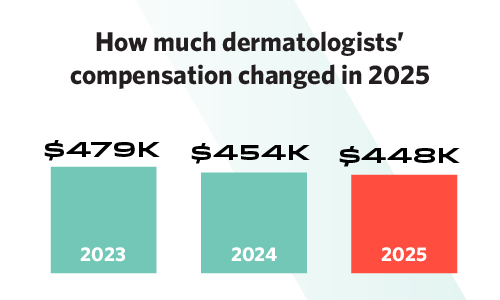
The $448,000 average lands dermatology 10th among the roughly 29 specialties Medscape tracks, just under the $500,000 mark that eight other specialties cleared. While cardiology, radiology, anesthesiology, and orthopedics all posted strong pay and strong growth, dermatology sits in the opposite group: flat to declining for two consecutive reports.
Meanwhile, 65% of dermatologists said they felt fairly paid individually, up from 55% the year before. Medscape's own analysts suggest this year's improvement likely reflects a rebound from burnout, easing pressure to see more patients, and lighter documentation loads, rather than the compensation number itself improving.
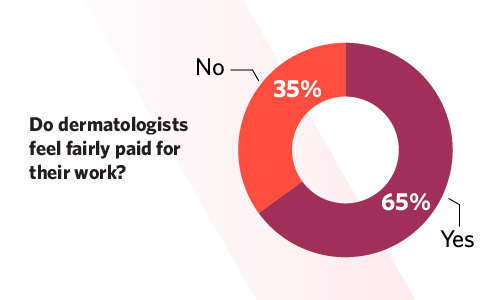
The forward-looking data backs this up: Fewer dermatologists expect a pay decrease this year (11%, down from 20% last year), and more expect at least some increase (49%, up from 46%). Sentiment is tracking relief from other career pressures and a better outlook, not a reversal in trailing pay.
What's driving the pay decline
Medscape's own analysts pointed to a pattern across this year's declining specialties, not something specific to dermatology: Private-practice physicians are encountering Medicare reimbursement rates that haven't kept pace with rising costs.
“With costs going up and reimbursements staying flat, of course, private practice physicians are not real positive on the outlook for their wages,” said Chad Stutelberg, national managing director of healthcare compensation and rewards at Arthur J. Gallagher & Co.
That's a real, structural pressure, and it's not one that resolves itself in a single good year. It's worth understanding the context before looking at what's actually within your control.
Ways to increase your dermatology compensation
There are several ways that dermatologists can increase their earnings while continuing to practice medicine, such as:
Negotiating more assertively
Sixty-seven percent of dermatologists said they didn't negotiate more than “moderately” aggressively the last time they discussed salary in their contract, close to the 63% figure for physicians generally. Some of that is structural, as plenty of physicians simply aren't given the opportunity to bargain, but for those who are, there may be more room than the current numbers suggest.
Understanding what actually drives your bonus
Seventy-four percent of dermatologists qualify for an incentive bonus, and the two leading factors that move it are RVUs generated (50%) and the number of procedures performed (39%). If you don't know what your own bonus structure rewards are, that's worth a direct conversation with your employer, since it changes where your effort actually pays off.
Considering outside work
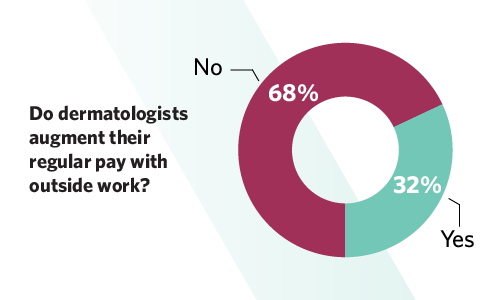
Thirty-two percent of dermatologists said they supplement their regular pay with outside work, whether additional hours, locum tenens work, medical moonlighting, or nonmedical work. It's not a good fit for everyone, but it's a useful way to boost earnings on the side.
Locum tenens is often used by physicians to earn supplemental income. It involves providing care on a temporary basis, from a single weekend to a recurring assignment, and can be worked alongside a full-time job.
The average pay for a locum dermatologist is $225 to $300 an hour, according to Locumstory. Actual pay varies by location, practice setting, experience, and demand, so treat this as a starting point for your own math rather than a guaranteed figure.

What is locum tenens? A beginner’s guide
Locum tenens by career stage
What locum tenens can look like depends on where you are in your career. Here are some ways dermatologists are increasing their wealth at every stage of their career using locum tenens.
Early-career dermatologists
Residency doesn't always prepare you to evaluate a practice, and signing a contract with an employer you've met for one interview is a real commitment made with limited information. It's exactly the situation many dermatologists face right out of residency.
Dr. Amanda Daggett went straight from her dermatology residency at Tulane into locum tenens rather than take a staff job first. “I don't want to sign a permanent contract with somebody that I interview with for one day,” she says.
She also finished residency without a clear sense of where she wanted to land, geographically or professionally. Locum tenens let her earn income while she figured it out, rather than locking into a permanent contract before she'd seen what her options actually looked like.
Locum tenens also gave her a way to see a hospital-system practice, a private-equity-backed practice, and a solo private practice, gaining experience in several settings before committing to one.
Interested in locums? Why early-career dermatologists enjoy locums
Mid-career dermatologists
Dermatologists who have been working in the field for a while may also be interested in exploring their options, especially if they’ve decided they want to make a change.
After several years of solo practice, Dr. Nicole Cassler took on locum tenens work specifically to sample different practice settings, using assignments to test what she wanted without giving up income in the meantime.
Eventually, Dr. Cassler decided to return to a more permanent role because she missed seeing the same patients over time. That continuity is what she was ready for when she transitioned from a locum tenens relationship to her current permanent position.
For dermatologists already established in their careers, locum tenens can serve a similar purpose: a way to test a change in setting, geography, or schedule without walking away from a paycheck.
Is it right for you? The pros and cons of locum tenens
Late-career dermatologists
Physicians nearing retirement often use locum tenens to wind down gradually rather than stopping all at once.
In addition to continued income, locums allows dermatologists to cut back on their working hours by letting them choose their own schedule. This way, you can continue practicing medicine and keep your license active while reducing what may be full-time work hours.
There's no new contract to negotiate and no multi-year commitment required, which makes it a lower-friction way to stay clinically active on your own terms as you approach retirement.
Tax and structure considerations
Working locum tenens generally means working as a 1099 independent contractor rather than a W-2 employee.
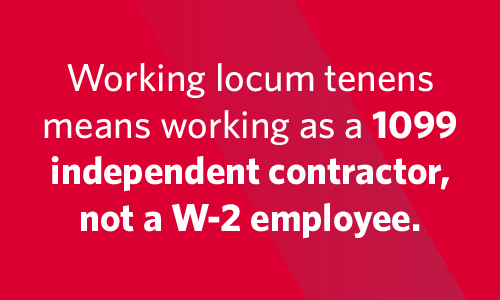
This means you're responsible for paying your own taxes quarterly rather than having them withheld from your paycheck. You'll also need to secure your own health insurance. Finally, malpractice coverage is also required, though this is often provided if you work assignments through an agency.
Dr. Daggett set up her own LLC specifically to help with her retirement contributions, which she described as a convenient structure once it was in place. A solo 401(k) structure, like the one Dr. Daggett used, can allow for retirement contributions beyond what a traditional employer plan permits.
The harder part, she says, was sourcing her own health insurance. “That was a massive undertaking,” she said. “Even being in healthcare, it was very difficult to find my own health insurance. It was way harder than I thought it was going to be.” She ultimately found a plan that worked for her, but it took real time and effort, even for someone working in medicine.
Because every physician's tax and retirement situation is different, talk to a qualified tax advisor, financial planner, or CPA before making decisions about your own structure.
Want to know how to manage locums income? Check out: The finances of locum tenens
Do the math for yourself
Curious what locum tenens could actually mean for your bottom line? Click below to find free calculators that estimate your potential locums earnings and show how much faster you could pay off your debt. It only takes a few minutes to see the numbers for yourself.
Whether you're finishing residency, weighing a career change, or easing toward retirement, locum tenens can help. View current dermatology locum tenens assignments, or give us a call at 954.343.3050 to speak with a Weatherby dermatology consultant.
Recommended Articles
Categories

Thank you,
We appreciate you contacting us. A consultant will be reaching out to you shortly to discuss this job opportunity. You can also get in touch with us directly by calling 954.618.5296.