
Emergency medicine salary report 2026: How to increase ER doctor pay
August 28, 2026
Emergency medicine physicians in the U.S. reported a better year for pay in 2025 than the year prior. According to Medscape's 2026 Physician Compensation Report, EM physicians earned an average of $421,000 in total compensation, up roughly 8% year over year and comfortably ahead of the 2.7% inflation rate in the U.S.
However, only 57% of EM physicians say they feel fairly paid individually, and 61% believe the medical profession is generally underpaid. Physician pay perception is shaped as much by patient volume, documentation load, and staffing pressure as it is by the number on the paycheck. A raise doesn't undo a hard year, and 2025's modest optimism looks more like relief than satisfaction.
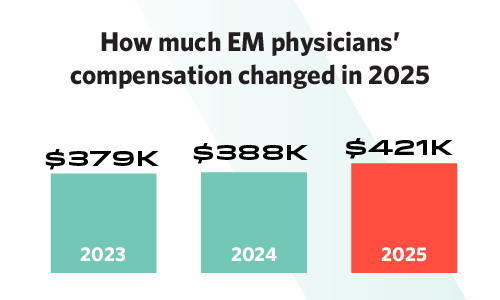
Take a look at where EM pay actually stands, the different ways physicians can increase their compensation, and why a growing number of EM physicians are also building locum tenens into their financial plan.
Where EM pay stands today
At $421,000, emergency medicine ranks 14th out of the 29 specialties Medscape tracked in 2026: solidly middle of the pack, below the eight specialties that cleared $500,000 (orthopedics, cardiology, radiology, and others) but ahead of primary care and several other specialties.
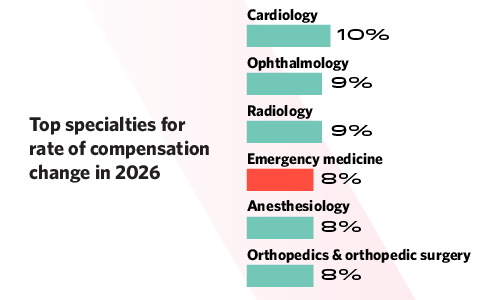
The 8% growth rate puts emergency medicine in the top five specialties in terms of compensation growth, with only cardiology, ophthalmology, and radiology seeing higher rates of growth at 10%, 9%, and 9%, respectively. Anesthesiology and orthopedics also grew at 8%.
Whether that paycheck actually covers what a physician's family needs is a separate question, and the answer splits close to a third each way: 29% say their pay exceeds their family's needs, 49% say it matches, and 22% say it falls short. That's essentially identical to how physicians in every specialty responded, so EM isn't an outlier here. It just means that for roughly one in five EM physicians, the number on the offer letter isn't enough on its own.
Ways to increase your compensation
Before considering supplemental employment, it's worth asking what room there is within a standard employment contract. For a lot of EM physicians, the answer is more than they might assume.
Negotiation
About half of EM physicians (52%) didn't get more aggressive than “moderately aggressive” the last time they negotiated their contract, and many told Medscape they didn't have a real opportunity to negotiate at all. That's not a judgment on anyone's ability to advocate for themselves. It's a sign that a meaningful share of the field is leaving room on the table simply because the conversation never happened.
Learn the skills: How to negotiate a better contract
Understanding your bonus structure
Sixty-two percent of EM physicians qualify for an incentive bonus, averaging $46,000 a year, which is not a small number to leave unoptimized. The top three factors that impact the bonus are: RVUs generated (cited by 57% of physicians as a factor), quality care metrics (45%), and patient satisfaction ratings (38%). A physician who knows exactly which elements their employer weighs most heavily is in a much better position to influence their bonus than one treating it as a fixed number that happens to them each quarter.

Taking on additional work
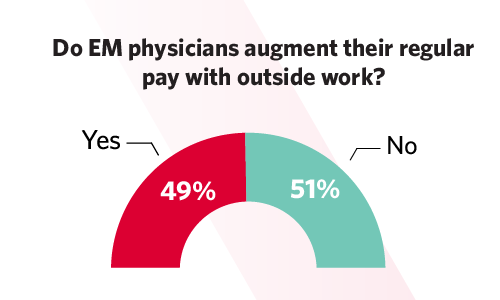
Roughly half of EM physicians (49%) already supplement their regular pay with outside work, whether that's picking up extra shifts, moonlighting, or earning non-medical income. It's already a common enough practice that it's closer to the norm than the exception.
For physicians who've already pushed on negotiation, bonus structure, and picking up extra shifts—and still feel like they've hit a ceiling—locum tenens is another option, and it’s one built around a genuinely different pay structure than employed work.
Why EM physicians are turning to locums to build wealth
Locum tenens EM assignments currently pay between $250 and $300 per hour, according to Locumstory. That figure will vary by location, setting, experience, and shift type, but the structural difference from employed pay is the real point; locum income isn't capped by the same negotiation ceiling as a base salary, because it's priced per assignment rather than set once and revisited every year or two.

In addition to increased pay, emergency medicine physicians enjoy locum tenens due to its flexible schedules, work-life balance, and ability to work in different locations and practice settings. As a contractor, you also don’t have to deal with as many administrative commitments as an employed physician.
Read about both sides: The pros and cons of locum tenens
Early career: Paying off debt and building a financial runway
Emergency medicine physician Dr. Ali Chaudhary took a full-time job right out of residency at one of the busiest surgery centers in the country. He started picking up locum shifts alongside that job specifically to pay down his student debt faster. “I had started doing locums while I had my full-time job to supplement my income and pay my student debt off quicker,” he says.
What happened next surprised him. “I could work the same amount and make a lot more money, or work less and make the same amount of money as I was at my full-time job.” He left the full-time role about two years in. Today he splits his time between locum shifts and his own business, and he describes the shift in blunt financial terms: staying in the full-time job “didn't make any sense from a financial standpoint.”
I realized I had full flexibility and was getting paid more doing locums than I was at my full-time job.
For a physician early in their career, the appeal isn't necessarily a full transition away from employment. It's using locums work the way Chaudhary did at first: as a way to accelerate debt payoff and build savings faster than a single paycheck allows, while deciding at their own pace what a longer-term practice setting should look like.
Mid-career: Choosing what work looks like on your own terms
Not every mid-career locum physician is layering shifts onto a full-time job. Some make the opposite choice: leaving employed practice behind to work locum tenens exclusively.
Dr. Ripal “Rip” Patel took a staff position in Houston after residency. Over time, the day-to-day of hospital medicine wore on him; metrics, patient satisfaction scores, and layers of administration made it harder to practice the way he wanted to. He eventually became a full-time locum tenens physician instead, building out his credentials across Texas, then into New Mexico and several other states.
The decision changed more than his schedule. As he describes it, “the pure joy of this model is being your own boss,” free to decide how much to work, when to take time off, and when to walk away if an assignment stops being the right fit. Today, he splits his time between locum shifts, running his own practice consultancy, and talking with residents, medical students, and burned-out colleagues considering the same path he took.
Late career: Easing into retirement without a hard stop
Dr. Mary Wadika had been practicing emergency medicine for about 30 years when she transitioned from full-time work to roughly two 10-hour shifts a week, easing into retirement rather than stopping outright.
Financial obligations are the primary reason she hasn't fully stepped away. A reduced, locum-based schedule lets her keep earning at a pace that matches her actual financial commitments, rather than her calendar dictating an income cut she isn't ready to absorb.
Wadika has been able to take assignments at a variety of hospitals, thanks to the credentialing team at Weatherby that assists with paperwork and approvals. Obtaining credentials at a new hospital independently “takes six to eight months,” she says, and doing it on your own across multiple hospitals is close to impossible. Working with Weatherby solved that problem for her.
Work with the best: Top locum tenens agencies in 2026
The real cost of going independent
Working locum tenens is an alternative to becoming a W-2 employee at a health system or practice, and the physicians who've experienced it are direct about the tradeoffs.
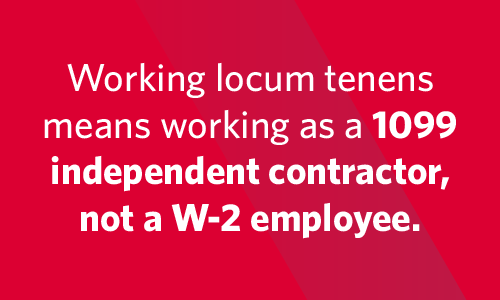
Dr. Jim Mock has worked as an independent contractor for years, and one cost stands out to him above the others: health insurance. “The one downfall of being an independent contractor is having to purchase your own health insurance,” he says. “I spend $2,000 a month on healthcare.”
For comparison, a hospital employee with a family plan might pay closer to $500 a month for similar coverage. Mock has weighed that trade-off and made a deliberate choice; he once turned down a benefits package worth an estimated $20,000 a year because accepting it would have meant a roughly $70,000 salary cut. “I politely told them no,” he says, “and that's when I became a locum.”
Dr. Ali Chaudhary has structured his locum income through an S-corp and says there are real tax advantages available to physicians willing to do the work of understanding independent contractor status. Exactly what those advantages look like depends heavily on individual circumstances, income, and location.
The information above is general in nature and shouldn't be treated as tax, legal, or financial advice. Every physician's situation is different, and actual tax treatment, deductions, and benefits will vary based on individual circumstances. Talk to a qualified tax advisor or financial planner before making decisions about independent contractor status, retirement contributions, or benefits tradeoffs.
Review your options: Finances of locum tenens
Do the math for yourself
Curious what locum tenens could actually mean for your bottom line? Click below to find free calculators that estimate your potential locums earnings and show how much faster you could pay off your debt. It only takes a few minutes to see the numbers for yourself.
Whether you're finishing residency, weighing a career change, or easing toward retirement, locum tenens can help. View emergency medicine locum tenens jobs, or give us a call at 954.343.3050 to speak with a Weatherby EM consultant.
Recommended Articles
Categories

Thank you,
We appreciate you contacting us. A consultant will be reaching out to you shortly to discuss this job opportunity. You can also get in touch with us directly by calling 954.618.5296.