
Family medicine salary report 2026: How much do family physicians make?
September 10, 2026
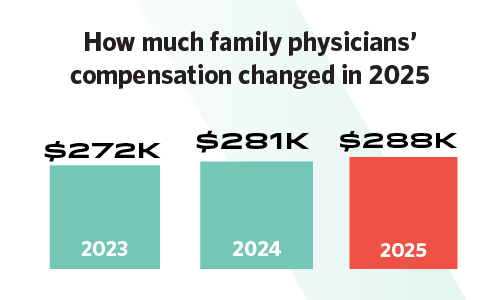
Family physicians earned an average of $288,000 in total compensation in 2025, an increase of about 2% from the year before, according to Medscape's 2026 Family Physician Compensation Report. That's the second-lowest growth rate among the 29 specialties Medscape tracked this year, and it leaves family medicine near the bottom of the overall pay table.
That modest growth lines up with how family physicians say they feel about their pay. Only 54% say they feel fairly compensated individually, and 58% believe the profession as a whole is underpaid. Family physicians also reported working an average of 48 hours a week, up from 47 hours the year before.
Read on for more findings from the report, along with practical ways to increase your family medicine compensation and how locum tenens fits into the picture at any career stage.
How much do family physicians make?
That $288,000 average, which includes base salary, incentive bonuses, and other income such as profit-sharing, places family medicine fifth from the bottom among the 29 specialties Medscape surveyed—ahead of only diabetes and endocrinology/rheumatology, infectious diseases, public health and preventive medicine, and pediatrics. Meanwhile, eight specialties broke $500,000 in average total compensation last year; family medicine wasn't one of them, and its 2% growth rate was a fraction of what several higher-earning specialties saw over the same period.
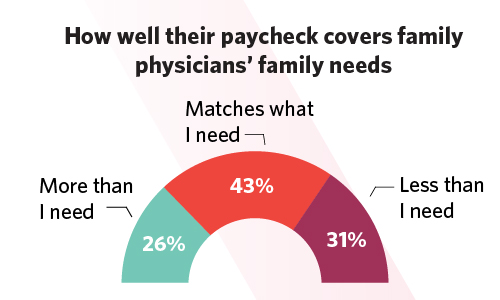
Asked whether their pay covers the essentials—family living expenses, mortgages, other debt, and retirement savings—43% of family physicians said it matched their needs, 31% said it fell short, and 26% said it exceeded what they needed.
Family medicine incentives and bonus earnings
About 64% of family physicians qualify for an incentive bonus, which averaged $30,000 in 2025, up from $29,000 the year before.

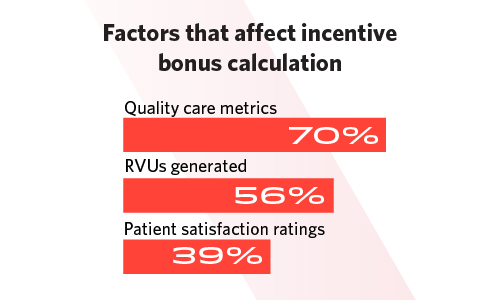
Quality-of-care metrics (70%) and RVUs generated (56%) are the two biggest factors in that bonus, a structure that rewards patient volume and documentation as much as clinical outcomes.
Looking ahead, 45% of family physicians expect a compensation increase in 2026, up from 40% the year before; 39% expect flat pay; and 16% expect a decrease. AMGA's Chad Stutelberg ties much of that caution to private-practice physicians facing pressure from Medicare reimbursement, with costs rising while reimbursement rates remain flat.
Contract length reinforces the same picture. 30% of family physicians work under contracts of a year or less, in line with physicians overall. AMGA senior director Matthew Wells connects short-term contracts like these to physicians pursuing locum tenens or per diem work specifically to improve work-life balance.
Ways to increase your family medicine compensation without changing employers
Before looking outside a current position, it's worth knowing what's actually negotiable. 69% of family physicians say they didn't negotiate more than “moderately” aggressively on their last contract, and many didn't have the opportunity to negotiate at all, as larger health systems move toward standardized compensation packages instead of individually negotiated ones.

If your pay is tied to RVUs or quality-of-care metrics, understanding exactly how your employer calculates that bonus is useful. Physicians who know which factors move the number can often influence it more directly than physicians who treat the bonus as an unknown.
Why more family physicians are turning to locum tenens
Given family medicine's comparatively low position in the pay rankings and limited room to negotiate, a growing number of family physicians are looking for income they can control more directly. Locum tenens is one way to do that.
Current locum tenens pay for family physicians runs $120 to $135 an hour, according to Locumstory. That's a meaningful supplement for a family physician earning $288,000 in a full-time role, enough to change the math on paying off debt faster, diversifying income mid-career, or easing into retirement without stopping altogether.
In addition to the pay, physicians who work locum tenens can decide where and how much they want to work. Assignments can range from one weekend a month to a full-time locums contract for several months, with the schedule flexibility and travel that comes with it.
Locum tenens at every stage of your career
Locum tenens is an adaptable career choice and can benefit family physicians at any stage of their career.

Early career family physicians: Locums as a financial head start
Family medicine's starting salary is among the lower entry points in medicine, and it comes with student debt loads comparable to those of physicians entering far higher-paying specialties. For a physician a few years out of residency, locum tenens hourly rates can outpace what an employed position pays, and that additional income can go directly toward student loan payments before the debt has a chance to compound.
It's also a way to try out different practice settings before committing to one. A locum tenens assignment lets a family physician sample a clinic, health system, or region before signing a contract that may include restrictive covenants that are hard to unwind later.
Dr. Linnea Williams, a family practice physician, started picking up locum tenens assignments right out of residency while working full time at a primary care clinic in Kansas City. “My hope is to be able to pay off student loans a little bit quicker,” she says. Now in solo private practice, Williams still works locum tenens roughly two weekends a month, covering urgent care sites in Missouri, Wisconsin, and Kansas, flying out Thursday evening and returning Sunday in time to open her own office Monday morning.
With locums, you pick what you want to do, when you want to do it. You have a lot of control over what happens.
Pay off med school debt: A comprehensive guide
Mid-career family physicians: Diversifying income on your own terms
By mid-career, locum tenens usually isn't about replacing an income shortfall. It's about diversifying how you earn and save: supplementing a permanent position's income, funding a specific goal like a child's tuition or an accelerated retirement timeline, or building a second income stream outside an employer's compensation structure. Given family medicine's comparatively flat pay growth and limited negotiating room, locum tenens work at this stage tends to function less as a lifestyle choice and more as a deliberate way to take control of income that a single job can't offer on its own.
That said, many mid-career physicians are ready for greater work-life balance, and family medicine doctors who work locum tenens full-time can choose when, where, and how much they work. This gives them time to travel, take time off to visit family or friends, or take care of children or aging parents. Some even choose a change of scenery by accepting an international locum tenens contract.
Read more: A beginner’s guide to international locum tenens assignments
Late career family physicians: A bridge to retirement
For family physicians approaching retirement, locum tenens often serves less as an ending and more as a bridge.
Dr. Jeffrey Culpepper, a board-certified family physician, started locum tenens work in March 2025, after his wife retired from a 31-year teaching career. “She said, ‘I want to travel more’,” he says. “And I had always wanted to do that myself.”
His first assignment took him to Montgomery, Alabama, for five and a half months, where he helped a practice get up and running. From there, Weatherby placed him in Tucson, Arizona, where he's continued practicing a value-based care model focused on elderly patients.
I feel like I have extra time to spend with the patients and dig deep into their health problems.
At 60, Culpepper isn't ready to stop practicing medicine. He's also no longer interested in the pace of a full-time, permanent role. “This is a great kind of transition between full-time medicine and retirement,” he says. “The stress level is lower. It's really nice being able to go into work, see the patients, interact with the staff members, and then go home and rest and have a life outside of the office.”
He also points to practical benefits that matter more at this career stage: corporate housing at each assignment, and travel costs covered by the company rather than out of pocket. And despite moving between short-term assignments, he says patient relationships haven't suffered. “I've had multiple patients ask me if I'd be willing to stay,” he says.
Thinking of retiring soon? Why using locums to transition makes sense
Tax and 1099 considerations for family physicians
For physicians considering locum tenens work, many want to know what changes when income is reported on a 1099 instead of a W-2.
As an independent contractor, a locum tenens physician is generally responsible for their own quarterly estimated tax payments, since there's no employer automatically withholding taxes. Health insurance and retirement contributions, through vehicles such as a solo 401(k) or SEP-IRA, also shift from an employer's plan to one a physician manages directly.
This is general information, not individualized tax or financial advice. Tax treatment varies by state, income level, and business structure, and any family physician considering a shift toward 1099 income should talk with a CPA or tax advisor familiar with physician finances.
Tips for managing locums income: The finances of locum tenens
Do the math for yourself
Curious what locum tenens could actually mean for your bottom line? Click below to find free calculators that estimate your potential locums earnings and show how much faster you could pay off your debt. It only takes a few minutes to see the numbers for yourself.
Give us a call at 954.343.3050 to speak with a consultant or view today's family medicine locum tenens job opportunities.
Recommended Articles
Categories

Thank you,
We appreciate you contacting us. A consultant will be reaching out to you shortly to discuss this job opportunity. You can also get in touch with us directly by calling 954.618.5296.