
Gastroenterologist salary report 2026: How to increase your GI doctor pay
August 27, 2026
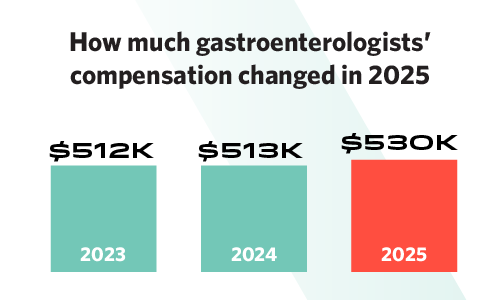
Gastroenterologists reported real pay growth in 2026, a shift after a year of essentially flat compensation. Average total compensation reached $530,000 in 2025, up from $513,000 in 2024 and $512,000 in 2023, according to Medscape's 2026 gastroenterologist compensation report.
Alongside that growth, 54% of gastroenterologists now say they feel fairly compensated, a sharp jump from 39% the year before. However, 46% of gastroenterologists still believe the profession generally is underpaid, and 18% expect their own pay to decline this year.
Read on to understand what GI pay looks like right now, the different ways in which you can influence your compensation, and how locum tenens fits into a broader financial plan at any career stage.
Where GI pay stands in 2026
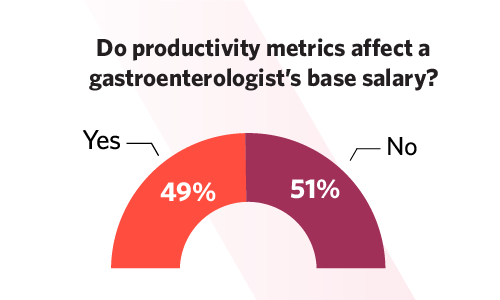
Gastroenterologists reported earning an average of $530,000 in 2025, with compensation increasingly tied to productivity. Nearly three in four gastroenterologists (72%) qualify for an incentive bonus, and RVUs generated are the single biggest factor in that bonus, cited by 71% of respondents. Even more notably, 49% of gastroenterologists say productivity metrics like RVUs now directly affect their base salary, not just a bonus on top of it, up from 45% the year before.
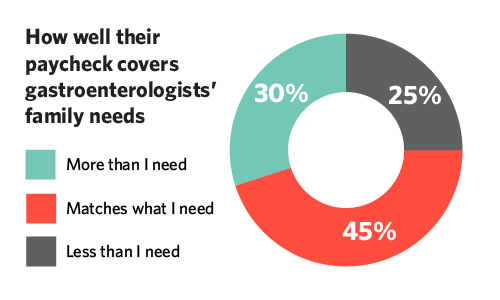
That structure rewards volume and efficiency, but it also means a slow patient quarter or a systemwide reimbursement change can move your paycheck in ways a flat salary wouldn't. Only 30% of gastroenterologists say their pay exceeds their family's needs, while 45% say it matches their family's needs, and 25% say it falls short, numbers that have held roughly steady year over year.
Work hours haven't changed much either. Gastroenterologists report an average 52-hour work week, the same as last year. Interestingly, 28% of gastroenterologists work under contracts of a year or less. AMGA senior director Matthew Wells, who studies physician compensation broadly, connects these short-term contracts to physicians pursuing locum tenens or per diem work specifically to improve work-life balance.
Ways to increase your compensation without changing employers
Before looking outside your current position, it's worth knowing what's actually negotiable. Sixty percent of gastroenterologists say they didn't negotiate more than “moderately” aggressively on their last contract, and 25% had no opportunity to negotiate at all.
If your pay is RVU-driven, understanding exactly how your employer calculates that bonus, whether it weighs patient mix, payer mix, quality metrics, or throughput, is useful. Physicians who know which factors increase pay can often influence it more directly than physicians who treat the bonus as a black box.
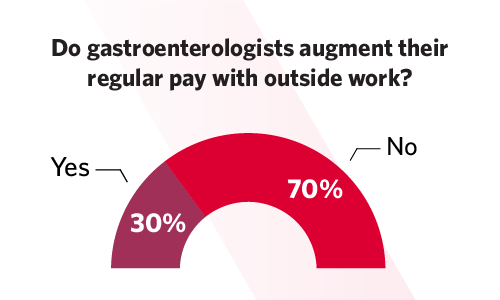
Taking on additional work is another strategy: 30% of gastroenterologists report doing supplemental work to augment their income, though that's down from 34% the year before. For physicians who've already negotiated what they can and don't want to take on more hours at their current job, locum tenens work can be a good option.
Why more gastroenterologists are turning to locum tenens
Given how much GI compensation now depends on productivity metrics you don't fully control, a lot of gastroenterologists are looking for income they can control more directly. Locum tenens is one way to do this.
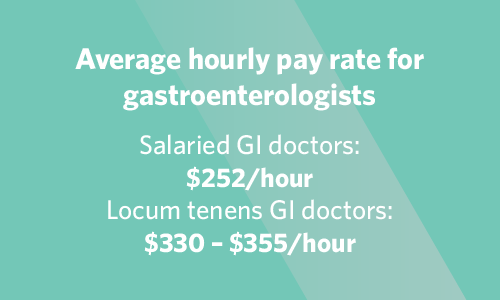
Current locum tenens pay for gastroenterologists runs $330 to $355 an hour, according to Locumstory, compared to an hourly base rate of $252 for salaried GI doctors. This rate means you’ll be paid for the hours you work, without having to worry about bonus structures, RVUs, or additional administrative responsibilities.
In addition to increased pay, physicians who work locum tenens decide where and how much they want to work. Assignments can range from as little as one weekend a month to a full-time locums contract lasting several months. Schedule flexibility, improved work-life balance, and the ability to travel are also elements that attract physicians to work locums.
Locums for gastroenterologists: Earn more and work less
Locum tenens at every stage of your career
Locum tenens is an adaptable career choice and can benefit GI physicians at any stage of their career.
Early-career gastroenterologists: locums as a financial head start
For a gastroenterologist a few years out of fellowship, locum tenens hourly rates can outpace what an employed position pays, and that additional income can go directly toward student loan payments. Paying down medical school debt faster, before it compounds over a decade or more, is one of the more direct financial arguments for locums early on.
It's also a way to try out different practice settings and locations before committing to either. A locum assignment lets you sample a hospital system, a region, or a patient population before signing a contract, one that often comes with restrictive covenants like non-competes or relocation clauses that are hard to unwind once you're in them.
For a physician who isn't yet sure whether they want academic medicine, a community hospital, or private practice, or isn't sure they want to live where their fellowship happened to land them, locums provides time to find out without a multi-year commitment. That same flexibility makes it easier to build savings ahead of the next major financial decision on your own timeline.
Pay off med school debt: A comprehensive guide
Mid-career gastroenterologists: a way to renegotiate control
By mid-career, locum tenens usually isn't about replacing an income shortfall. It's about renegotiating control: supplementing a permanent position's income, funding a specific goal like a child's tuition or an accelerated retirement timeline, or testing whether a full-time locums schedule could actually replace an employed position, minus the administrative structure that comes with it.
Dr. Edward Lung spent 23 years in academic medicine before making that shift. He'd been a professor of medicine at a major academic center, comfortable with the work but wanting more control over his schedule and where he could live. “That was really the impetus for doing locums, to get more freedom of schedule and agency over my time, to have more time with my family," he says.
I wanted more freedom over my schedule, and I wanted more freedom over where I could work, travel, and explore.
Giving up the security of a known institution after two decades wasn't a small decision. Lung has a family of four, and the uncertainty of not knowing where he'd be working in three or six months was, in his words, “a little bit scary in the beginning.” So, he worked with his Weatherby consultant to map out assignments a year at a time, and turned an open-ended unknown into something he could budget for and plan a family around.
Late-career gastroenterologists: a longer runway before full retirement
For physicians later in their careers, locum tenens commonly serves one of two financial goals: a final, focused push to fund a retirement account before stepping back, or a way to stay clinically active on a reduced, self-determined schedule.
After 26 years running his own practice in San Diego, Dr. Robert Brenner was facing a shrinking referral base as his practice's referral network consolidated around him. So he and his wife decided to go on the road while he worked locums assignments.
His plan has a clear finish line: pay off remaining debts over the next three years, then work half the year for roughly seven more years to fund retirement. “I don't plan to go back to a permanent job like I had the rest of my career,” he says. “As long as locums works, I'll keep doing that.”

My priority is to make as much as I can in as short a time as possible and still have time to go home and be with my family.
Dr. Duane Webb, working as a gastroenterologist since 1980, retired and took a three-month sailing trip to Alaska with his wife. Then he decided full retirement wasn't quite what he wanted yet, so he signed on part-time as a locum instead. For a physician who isn't ready to fully stop practicing but doesn't want the demands of a full-time role either, locum tenens can be the perfect middle ground.
Thinking of retiring soon? Why using locums to transition makes sense
The real cost (and reward) of independence: Taxes and 1099 structure
Locum tenens physicians are typically paid as 1099 independent contractors rather than W-2 employees, which changes some of the basics: You'll pay estimated taxes quarterly rather than having them withheld, and you're responsible for sourcing your own health insurance and malpractice coverage rather than having an employer provide them. Most locum tenens physicians work with an accountant familiar with 1099 income, since deductions and planning differ from those in a standard employed position.
There's an upside to the 1099 structure, too. Independent contractors have access to higher retirement contribution limits than a standard employer plan allows, through vehicles like a solo 401(k) or a SEP-IRA, which is useful if, like Brenner, your plan includes “putting some money away” once other debts are handled.
At higher income levels, physicians may also be able to take the Qualified Business Income deduction or consider an S-corp election, both of which are worth a conversation with a tax professional to see if they’re right for you.
This isn't tax or financial advice. Every physician's situation is different, and decisions about 1099 income, retirement contributions, and entity structure should be made with a qualified tax advisor or financial planner who can review your specific numbers.
Tips for managing locums income: The finances of locum tenens
Do the math for yourself
Curious what locum tenens could actually mean for your bottom line? Click below to find free calculators that estimate your potential locums earnings and show how much faster you could pay off your debt. It only takes a few minutes to see the numbers for yourself.
Give us a call at 954.343.3050 to speak with a consultant or view today's gastroenterology locum tenens job opportunities.
Recommended Articles
Categories

Thank you,
We appreciate you contacting us. A consultant will be reaching out to you shortly to discuss this job opportunity. You can also get in touch with us directly by calling 954.618.5296.