
Health insurance options for locum tenens physicians: What every 1099 should know
October 06, 2026
One of the best parts of working as a locum tenens physician is the flexibility and freedom to choose when and where you work. That independence also means moving away from an employer-selected benefits package, but it doesn't have to be a hurdle that stands between you and the locum tenens career you want.
To help make that process easier, Weatherby Healthcare partnered with Leavitt Group and its Enroll365 program for an updated 2026 webinar on healthcare coverage for locum tenens providers. Leavitt Group's advisors walked through medical plan options, the year's most important regulatory updates, supplemental benefits, and what to expect from enrollment.
These benefits are available to independent contractors through a third-party program. No employment relationship exists or is created. All providers maintain 1099 independent contractor status.
2026 updates every locum tenens provider should know
Two changes in the individual health insurance market are especially relevant for locum tenens providers evaluating coverage in 2026.

Enhanced ACA Marketplace premium tax credits expired after 2025. Financial help still exists for eligible Marketplace enrollees, but some higher-income households no longer qualify, and many consumers are seeing higher net premiums in 2026. That makes it especially important to compare the full cost of coverage and estimate household income carefully before enrolling.
HSA eligibility expanded for 2026. Bronze and catastrophic individual plans can now be treated as HSA-compatible, which expands the number of people who may be able to contribute to a health savings account. The 2026 HSA contribution limits are $4,400 for self-only coverage and $8,750 for family coverage. For locum tenens providers who like the idea of setting aside tax-advantaged money for future healthcare expenses, this change may open up new options worth evaluating.
Health savings accounts involve tax considerations that vary by individual circumstances. Consult a qualified tax advisor or financial planner to understand how these changes apply to your situation.
Your main paths to medical coverage
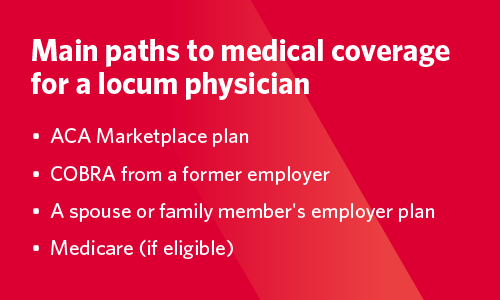
Not every locum tenens provider needs to start from scratch with an individual Marketplace plan. Depending on your circumstances, your primary medical coverage could come from an ACA Marketplace plan, COBRA from a former employer, a spouse or family member's employer plan, Medicare (if you're eligible), or another individual medical option available in your state.
ACA Marketplace and individual family plans
ACA Marketplace plans are government-regulated, major medical plans available in all 50 states. They cover essential health benefits such as hospital care, prescriptions, and mental health services. They can't deny coverage or charge more for pre-existing conditions, and they cap your annual in-network out-of-pocket costs.
Lower-premium plans typically carry higher out-of-pocket costs, while higher-premium plans may reduce what you pay when you need care.
Available from major carriers such as Blue Cross Blue Shield, Cigna, and UnitedHealthcare.
If you regularly take assignments outside your home state, review the provider network closely, since access to non-emergency care may vary by location.
The ACA Marketplace open enrollment period runs from November 1 to January 15, and enrolling by December 15 typically allows coverage to start January 1. Outside of open enrollment, you generally need a special enrollment period to enroll in or change coverage.
COBRA and other employer-based coverage
COBRA may allow you to continue a former employer's health plan temporarily, allowing you to keep the same plan, network, and treatment relationships for a period of time. However, once you leave the employer, you may be responsible for most or all of the premium cost the employer previously helped cover. Coverage through a spouse or family member's employer is another option worth comparing when it's available.
When weighing these choices against a Marketplace plan, look beyond the monthly premium. Compare the deductible, family deductible, prescription coverage, provider network, maximum out-of-pocket amount, and how well the plan works with your travel and assignment patterns.
Short-term and alternative medical products
Short-term and other alternative medical products are available in some states and can sometimes be useful for a temporary gap. They are not the same as ACA-compliant major medical coverage, and rules around pre-existing conditions, covered services, benefit limits, prescriptions, maternity care, and mental health services can differ significantly by carrier and by state. Federal rules governing these products have changed in recent years, so confirm the exact product and duration available to you when you enroll.
Short-term coverage isn't inherently good or bad. It solves a different problem than comprehensive coverage does. If you're considering one of these plans, ask specifically: What is excluded? Is there a dollar cap? How are prescriptions handled? What happens if you develop a serious condition during the coverage period? And would this plan protect you from the financial risk you're trying to insure against?
Supplemental coverage: Filling the gaps
Supplemental insurance can be useful, but it's important to understand its role. Dental and vision plans are fairly familiar, while other products work differently:
Accident coverage may pay defined benefits after a covered injury.
Critical illness coverage may provide a lump sum benefit after a covered diagnosis such as cancer, stroke, or heart attack.
Hospital indemnity coverage may pay a set amount based on a hospital stay or other covered event.
Depending on the policy, those benefits can help with deductibles, travel costs, household expenses, or lost income, but supplemental coverage generally isn't a replacement for comprehensive major medical insurance.
Income protection: A different risk than medical coverage
For independent contractors, income protection is an important consideration. If you're unable to work for several weeks or months because of an illness or injury, you may not have the same employer-sponsored sick leave or disability benefits you had in an employed position.
Medical insurance helps pay eligible healthcare costs. Disability or income protection coverage helps preserve your income when you can't work. For a physician or advanced practice provider whose income depends directly on taking assignments, income protection or disability coverage is an important option to consider.
Building coverage in layers
A practical way to put all of this together is to think in layers rather than search for a single policy that does everything.
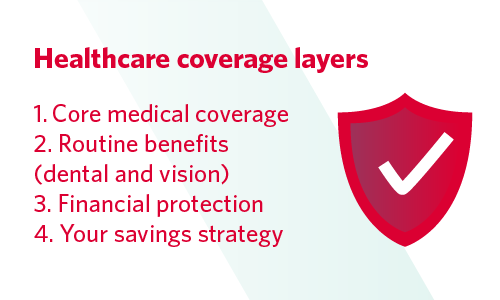
Layer 1: Core medical coverage. This might be an ACA plan, COBRA, Medicare, or coverage through a spouse.
Layer 2: Routine benefits. Coverage you expect to use more regularly, such as dental or vision.
Layer 3: Protection against financial shocks. Coverage for specific events such as an accident, hospitalization, critical illness, or a period when you can't work.
Layer 4: Your own savings strategy. For eligible individuals, an HSA can be one way to set aside money for qualified healthcare expenses while receiving tax advantages.
The goal is to decide which risks you want to transfer to insurance and which risks you're financially comfortable carrying yourself.
Common coverage bundles for locum tenens providers
Leavitt Group's advisors describe four common coverage approaches for locum tenens providers. These are examples, not fixed packages. The goal is to build coverage around your specific needs rather than a one-size-fits-all solution.
Essential Care Bundle: Comprehensive, year-round coverage that often combines an ACA major medical plan with dental, vision, and optional disability or accident coverage.
Bridge Coverage Bundle: Temporary coverage for providers transitioning into locums, such as COBRA or another short-term solution, while you evaluate long-term options.
Short-Term Safety Net Bundle: Coverage designed to fill a temporary gap, paired with a clear understanding of its limitations and a plan for future coverage.
Everyday Coverage Bundle: For providers who already have medical coverage and want to focus on benefits like dental, vision, accident, or disability coverage instead of duplicating medical insurance.
A locum-specific checklist before you choose
Before choosing coverage, work through this locum-specific checklist:
Where will you receive routine care? If you live in one state but regularly take assignments elsewhere, check whether non-emergency care outside your home area is covered and how the network functions.
Review your physicians, hospitals, and prescriptions. A plan can look similar on paper and still be a poor fit if a medication or specialist is treated differently.
Compare both the deductible and the maximum out-of-pocket amount. They answer different questions.
Consider your family. A plan that's attractive for one person may look different once a spouse or children are added.
Think about income volatility. If you receive Marketplace financial assistance, changes in household income can affect the amount of assistance you qualify for, so keeping your Marketplace information current matters.
Think about what an employer used to provide beyond medical coverage. Disability, life insurance, dental, vision, and other benefits can be easy to overlook when you're focused only on replacing the health plan.
Comparing your final options
Once you're down to two or three choices, use the same framework for each one:
Compare the annual premium, not just the monthly premium.
Compare the deductible, copays or coinsurance, prescription costs, and maximum out-of-pocket amount.
Check the network in the places where you live and work and review the plan's rules for out-of-network care.
Think through a normal year (preventive care, a few office visits) and a difficult year (surgery, hospitalization, or ongoing specialty treatment).
Add in any supplemental coverage you're considering.
That kind of side-by-side comparison usually gives you a clearer picture than the premium cost alone.
You don't have to figure this out alone
There are many coverage options, and the right choice depends on your individual situation. Leavitt Group's Enroll365 advisors are licensed in all 50 states, specialize in working with 1099 providers, and the service is free to use. They can help you compare plans, understand the differences, and identify the combination of medical and supplemental coverage that fits your assignments, family, budget, and health needs, at no cost to you.
For assistance, call 888.612.3398, email [email protected], or visit www.enroll365.com.
Frequently asked questions
Will I lose my health insurance if I leave an employed position for locum tenens work?
Moving from an employed role to locum tenens work generally means leaving an employer-selected benefits package behind, but it doesn't mean you're left without options. Depending on your circumstances, you may be able to get primary medical coverage through an ACA Marketplace plan, COBRA from your former employer, a spouse or family member's employer plan, Medicare (if you're eligible), or another individual medical option available in your state.
What are the main paths to health coverage for a locum tenens provider?
The main paths are an ACA Marketplace (or individual family) plan, COBRA continuation from a former employer, coverage through a spouse or family member's employer, Medicare (if eligible), short-term or other alternative medical products, and supplemental coverage such as dental, vision, accident, critical illness, or hospital indemnity plans layered around a primary medical plan.
What changed with ACA Marketplace premium tax credits for 2026?
The enhanced federal Marketplace premium tax credits that made coverage more affordable for many households in recent years expired after 2025. Financial help still exists for eligible Marketplace enrollees, but some higher-income households no longer qualify, and many consumers are seeing higher net premiums in 2026. It's worth comparing the full cost of coverage and estimating household income carefully before enrolling.
What is the 2026 HSA eligibility expansion, and what are the new contribution limits?
Starting in 2026, bronze and catastrophic individual health plans can be treated as HSA-compatible, which expands the number of people who may be able to contribute to a health savings account. The 2026 HSA contribution limits are $4,400 for self-only coverage and $8,750 for family coverage. A tax advisor can help you determine how this applies to your specific plan and situation.
Is COBRA a good option while transitioning to locum tenens?
COBRA can provide continuity, allowing you to keep the same plan, network, and treatment relationships for a period after leaving an employer. The trade-off is cost, since you may become responsible for most or all of the premium your former employer previously helped pay. Whether COBRA makes sense depends on your budget, how long you expect to need bridge coverage, and how it compares to a Marketplace plan or coverage through a spouse's employer.
Are short-term medical plans a good replacement for major medical coverage?
Short-term and other alternative medical products can be useful for a temporary gap, but they are not the same as ACA-compliant major medical coverage. Rules around pre-existing conditions, covered services, benefit limits, and prescriptions can vary by carrier and state, and availability has changed with recent federal rule changes. Before enrolling, ask what's excluded, whether there's a dollar cap, and whether the plan would protect you from the financial risk you're trying to insure against.
This article summarizes general information shared in Weatherby Healthcare and Leavitt Group's 2026 webinar and is not tax, legal, or financial advice. Insurance rules, availability, and pricing vary by state, carrier, and individual circumstances. Consult a licensed insurance advisor and a qualified tax professional before making coverage decisions.
Recommended Articles
Categories

Thank you,
We appreciate you contacting us. A consultant will be reaching out to you shortly to discuss this job opportunity. You can also get in touch with us directly by calling 954.618.5296.