
Medical oncologist salary report 2026: Where current pay sits and how to increase compensation
September 08, 2026
Oncologists in the U.S. saw their pay slip in 2025. According to Medscape’s Oncologist Compensation Report 2026, average total compensation for oncology and hematology physicians was $464,000 last year, down from $472,000 in 2024 and effectively flat with 2023's $464,000—one of nine specialties reporting flat or declining pay this year, compared with seven the year before.

The pay dip lines up with how oncologists say they feel about their compensation. Just 57% told Medscape they feel they are fairly paid individually, down from 64% the previous year. Meanwhile, oncologists reported working 52 hours a week on average, up from 50 hours the year before and above the 49-hour average for physicians generally.
Why oncologist pay is falling behind the workload
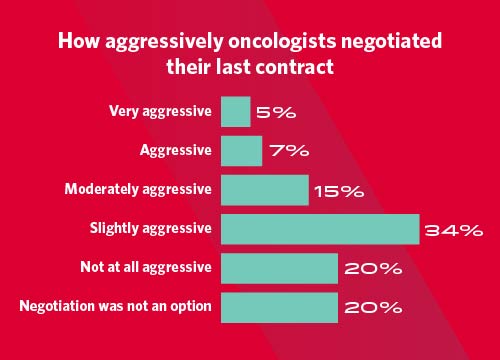
Part of the disconnect may come down to negotiating leverage. Sixty-nine percent of oncologists told Medscape they didn't get more than “moderately” aggressive the last time they negotiated a compensation package, close to the 63% of physicians overall who said the same. Many, the report notes, didn't have the opportunity to negotiate at all, as hospital systems have moved away from individually negotiated packages as they consolidate.
Contract length matters too. Medscape's data show 30% of physicians overall are under contracts of a year or less, compared with 43% on contracts of 13 months to three years and 28% on three-year or longer contracts. Matthew Wells, PhD, a senior director at AMGA Consulting, told Medscape that shorter contracts often reflect physicians “brought in for a short-term project” or pursuing “locum tenens or per diem jobs for improved work-life balance,” while the longest contracts tend to be evergreen deals renewed annually.
A shortage that's reshaping the oncology job market
Behind the pay numbers is a supply problem that's squeezing oncology harder than most specialties. In 2024, the average oncology job opening took 332 days to fill, according to AAPPR’s 2025 benchmarking report—and that's if it got filled at all. Three in five (59.6%) oncology searches went unfilled in 2024, with another 2.8% cancelled or on hold, leaving nearly two-thirds (62.4%) of open oncology roles effectively unresolved.

For health systems, that translates into millions in lost patient revenue per unfilled search. For oncologists, it translates into something more useful: leverage. A specialty this hard to staff permanently is also a specialty where a physician's time and flexibility carry real weight, whether that means negotiating a stronger contract or working on your own terms.
How locums fits into an oncologist's financial picture
This is where locum tenens work enters the picture—not as a stopgap, but as a direct response to both problems: pay that isn't keeping pace, and a market where oncologists are in short supply.
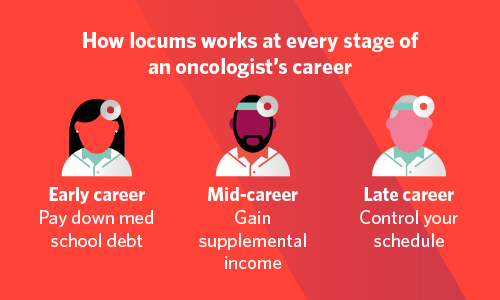
How that plays out depends on where a physician is in their career. For some, it's a way to pay down debt before settling into a first permanent role. For others, it's supplemental income and a way to diversify how they save for retirement. For physicians easing out of full-time practice, it's a way to keep working without keeping everything else that came with a full-time job.
Is locums right for you? The pros and cons of locum tenens
Early career: Using locums to pay down debt before settling in
Physicians fresh out of fellowship often carry the heaviest debt load of their career at the exact moment their income is just starting to catch up to it. A short-term locums assignment between finishing training and starting a full-time position can generate income during that gap without requiring a multi-year commitment. Locums can be a way to test different practice settings while making real progress on debt before locking in a schedule and a location under a contract.
Dr. Fuat Bicer took that route. After completing his oncology fellowship, he started a locums assignment in an underserved Ohio community five days later, using it as a bridge before beginning an academic oncologist role at Ohio State. The assignment let him generate income and pay down debt during the gap between training and his new position.
Hear from oncologists directly: 8 reasons medical oncologists are choosing locum tenens work
Mid-career: Locums as supplemental income
For physicians already in a stable, full-time position, locums work is often about supplementing income and diversifying how income is saved and invested.
Dr. Zartash Gul, a hematology/oncology physician subspecializing in transplant and CAR-T therapy, has spent the last decade working locums off and on alongside a full-time position, typically using vacation time or weekends. For her, the appeal is straightforward: “There is a shortage of physicians in the United States, especially, and locums helps us earn more,” she says.
Gul's subspecialty makes locums work harder to come by—transplant and CAR-T-focused assignments are less common than general oncology coverage—but she's found it worthwhile for the flexibility and the additional income alone.
Late-career: Trading administrative load for schedule control
Physicians nearing the end of a full-time career often face a choice that doesn't fit how they actually want to wind down: Either keep the full job, administrative load included, or leave medicine altogether. Locum tenens offers a way to keep practicing clinically on a self-selected schedule without the leadership and administrative responsibilities that come with a staff role.
Dr. Elizabeth Connelly retired from full-time oncology practice in 2021 and began locums work that September. She planned to work locums for a couple of years, but has kept taking assignments ever since. As a former department head, she estimates administrative and leadership work consumed 20-40% of her time in her prior role.
When you're doing locums work, you simply go and take care of patients. You don't lead programs, you don't go to meetings about administrative issues, you don't worry about a budget.
"All of the things that I did during my full-time work, I can let go of, except the part of taking care of patients," she says. "And that is amazing. That's like going back to the root of why I went to medical school.”
Connelly is also selective about how much she commits to at once. “I would only commit to three months maximum,” she says of her assignments, a level of control she describes as a real benefit of locums work. Her advice to physicians considering the same path: try a short assignment before committing to anything longer. “One nice thing about locums is you can try it, and if you don't like it, you can quit,” she says. “You'll know after one or two trips: this is good, or this is not good for me.”
Physician retirement strategy: Supplement your income with locum tenens
What locums pay means at tax time
Working locums comes with one difference physicians need to plan around: Locum tenens physicians are paid as 1099 independent contractors, not W-2 employees. That distinction affects how taxes are managed. Without an employer withholding income and payroll taxes automatically, locum physicians are typically responsible for paying quarterly estimated taxes themselves.
Locum physicians who are saving for retirement will want to set up a self-directed plan, such as a solo 401(k).
Additionally, securing individual health coverage becomes a physician's own responsibility. In Dr. Gul’s experience, this can be challenging. “You can do your 401(k)s, you can do all the other things. But the medical insurance is such a difficult thing to find,” she says. “It's hard to find good medical insurance even if you're willing to pay top dollar.”
None of this makes 1099 status a dealbreaker. Many physicians successfully manage retirement and insurance on their own, whether they're working locums full time or supplementing a W-2 role.
Manage your locums income: The finances of locum tenens
A tax advisor, financial planner, or CPA can help you understand how independent contractor status affects your specific tax and retirement planning. This article is provided for general information only and is not a substitute for individualized professional advice.
Do the math for yourself
Curious what locum tenens could actually mean for your bottom line? Click below to find free calculators that estimate your potential locums earnings and show how much faster you could pay off your debt. It only takes a few minutes to see the numbers for yourself.
Ready to see what’s possible?
Whether you’re paying down debt, want to increase your compensation, or just want more control over your schedule without giving up income, locum tenens is worth running the numbers on. Give us a call at 954.343.3050 to speak with a consultant or view today’s medical oncology locum tenens jobs below.
Recommended Articles
Categories

Thank you,
We appreciate you contacting us. A consultant will be reaching out to you shortly to discuss this job opportunity. You can also get in touch with us directly by calling 954.618.5296.