
OB-GYN salary report: What’s an OB-GYN earning in 2026?
September 04, 2026
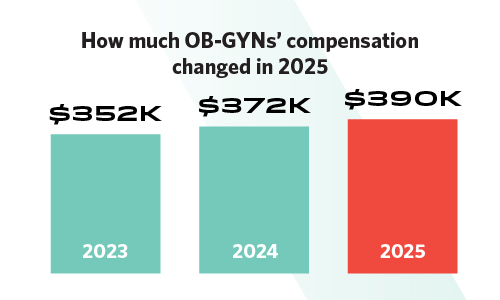
OB-GYNs averaged $390,000 in total compensation in 2025, up 5% from the year before, according to Medscape’s 2026 OB-GYN Compensation Report. That growth outpaced the roughly 3% average increase physicians reported across all specialties, and it stands out against a broader trend; nine specialties reported flat or declining pay this year, up from seven the year before.
More OB-GYNs are feeling better about their pay, too. Fifty-three percent say they feel fairly compensated, up from 40% last year, even as 71% still believe physicians generally are underpaid.
For those looking to increase their earnings, there are several ways to do so. Below, find more results from this year’s report as well as tips on how to earn more as an OB-GYN.
How OB-GYN compensation breaks down
OB-GYNs who qualify for an incentive bonus average about $47,000, and for 66% of them, RVUs generated is the single biggest factor in calculating it. That productivity link is loosening slightly rather than tightening: 36% of OB-GYNs say RVUs or similar metrics now directly influence their base pay, down from 43% the year before.
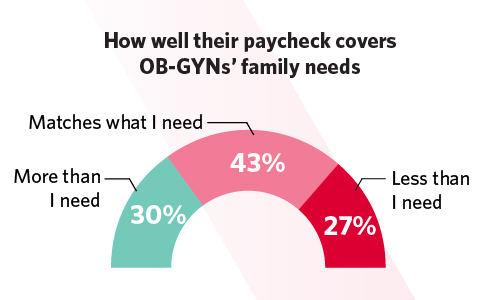
When Medscape asked how well that paycheck covers actual living expenses, debt, and retirement savings, only 30% of OB-GYNs said it covers more than they need. Forty-three percent said it matches what they need, and 27% said it falls short—numbers nearly identical to the 28% shortfall rate physicians report overall.
Why OB-GYN pay doesn’t always match the workload
Part of the disconnect may come down to negotiating leverage. Sixty-six percent of OB-GYNs told Medscape they didn’t get more than “moderately” aggressive the last time they negotiated a compensation package, close to the 63% of physicians overall who said the same. “The hospitals I work for once negotiated physician compensation individually, but that has changed as they became part of bigger organizations,” says Chad Stutelberg, national managing director of healthcare compensation and rewards for Arthur J. Gallagher & Co., who was interviewed by Medscape for this report.

Contract length matters too. Medscape’s data show 28% of OB-GYNs are under contracts of a year or less. Matthew Wells, PhD, a senior director at AMGA Consulting, told Medscape that shorter contracts often reflect physicians “brought in for a short-term project” or pursuing “locum tenens or per diem jobs for improved work-life balance,” while the longest contracts tend to be evergreen deals renewed annually.
Many OB-GYNs are already earning extra income
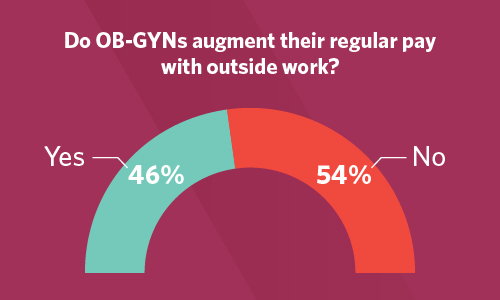
Last year, only 35% of OB-GYNs said they found time and opportunity to take on paid work outside their regular hours; this year, that’s true of 46%. Examples of this additional work include things like taking on more hours at their primary job, medical moonlighting, and nonmedical outside work.
Locum tenens is one form of medical moonlighting, along with per diem work. It isn’t necessarily an alternative to full-time employment—physicians can work locums on the side or as their primary gig. For a growing number of OB-GYNs, it’s simply a more structured, credentialed version of something many are already doing.
Is locums right for you? How locum tenens provides OB-GYNs with better work-life balance
What locum tenens OB-GYNs actually earn
Locum tenens pay for OB-GYNs currently ranges from $150 to $200 an hour, according to Locumstory. Additionally, internal CHG Healthcare research found that OB-GYNs have an increased interest in working locums; they were more likely to say they’d consider an extended assignment than physicians in other specialties surveyed.
Rates vary by location, assignment length, and experience, so this range is a starting point, not a guarantee for any individual assignment.
Find out more: How does locum tenens compensation work?
Locum tenens at every stage of your career
Locum tenens is an adaptable career choice and can benefit OB-GYNs at any stage of their career. Early on, it’s often about paying down debt. Mid-career, it’s more likely to be a bridge through a transition. And for physicians easing toward retirement, it’s a way to keep earning and practicing on their own terms.
Early career OB-GYNs: Locums as a head start to debt payoff
Between medical school and residency, six-figure loan balances are common for OB-GYNs, and it can be daunting to think about repayment when accepting your first job.
Dr. Ashita Gehlot, an OB-GYN, and her husband, Dr. Hevil Shah, a neonatologist, know that feeling well. Between the two of them, they were paying down medical school debt for two medical degrees. Locum tenens work gave them a way to attack that debt directly, as Gehlot worked assignments and Shah found a permanent position. “We were really able to hit hard on our loans,” Gehlot says.
After 18 months of working locum tenens assignments, the couple was able to completely pay off their debt.
Pay off med school debt: A comprehensive guide
Mid-career OB-GYNs: A way to renegotiate control
By mid-career, locum tenens usually isn’t about replacing an income shortfall. It’s about staying clinically active through a transition or making deliberate progress on a specific financial goal—without walking away from a career built over more than a decade.
That's what happened to Dr. Andrea Cobb; after 14 years in practice, her position ended. Rather than step away from clinical work entirely, she used locum tenens to stay active while she figured out her next step. “I needed to keep up my skills,” she says. “I said, ‘What can I do to make sure we keep this up?’ I decided I could do some locums in the meantime.”
Dr. Jacqueline Brown made a more deliberate switch. After roughly 15 years in academic practice, she left full-time work behind and now works as a locum tenens about nine months a year. The income tradeoff is real, and she’s candid about it: “I make a third of the money I used to make,” she says, “but I make enough to cover my mortgage, living expenses, and contribute the maximum amount that I can per year for tax-free savings.”
Late career OB-GYNs: A longer runway before full retirement
For OB-GYNs closer to the end of their careers, locum tenens tends to serve a different purpose: allowing them to practice the way they want, whether that’s fewer hours, a slower pace, or funding a specific financial goal.
Dr. Richard Salsman had been an OB-GYN since 1983. He sold his practice to a hospital in 2008 and spent about 10 more years as an employed physician before making the move to locum tenens full time as a deliberate step toward retirement.
“I got tired of doing the corporate thing,” he says. “I decided that as I got closer to retirement, I wanted to be able to pick my own hours, pick my own time, and do things that were more suited to just taking care of patients.” His advice to other physicians considering the switch is blunt: “Make sure you maximize your retirement plan; always do that.”
I wanted to be able to pick my own hours, pick my own time, and do things that were more suited to just taking care of patients.
Dr. Lanetta Coleman, an OB-GYN for more than two decades, came to locum tenens from a different angle. With two teenage sons approaching college, she wanted a way to cover tuition without dipping into the retirement savings she’d already built.
“I wasn’t interested in using my retirement to finance college,” she says. “So, locums was a good way for me to pay for my son’s college tuition.” For Coleman, locum tenens also functions as a bridge to the next phase of her career rather than a hard stop. “It allows me to be ready to retire on time and on schedule, and it also gives me a transitioning option”—a way to step back from the pace of full-time practice while still practicing medicine on her own terms.
Locums was a good way for me to pay for my son’s college tuition.
Physician retirement strategy: Supplement your income with locum tenens
What locum tenens means for your taxes
Working locum tenens comes with one difference physicians need to plan around: Locum tenens physicians are paid as 1099 independent contractors, not W-2 employees. Without an employer withholding income and payroll taxes automatically, locum physicians are typically responsible for paying quarterly estimated taxes themselves. Securing individual health coverage becomes their own responsibility, too. Physicians saving for retirement will want to set up a self-directed plan, such as a solo 401(k).
None of that has to be complicated. Salsman, for example, works with a CPA he’s trusted for 25 years to handle his tax deductions and quarterly filings. “I found him to be an invaluable resource,” he says. “I went and talked with him and just asked him about things—how to do my taxes, how to do my tax deductions, what is deductible, what is not deductible. He helped me a lot with that.” He also found an unexpected upside in the switch: “I get a lot more tax breaks because everything is tax-deductible.”
Every physician’s situation is different, and a tax advisor or CPA can help you understand what quarterly payments, self-funded benefits, and retirement contributions would actually look like for your income and situation.
Do the math for yourself
Curious what locum tenens could actually mean for your bottom line? Click below to find free calculators that estimate your potential locums earnings and show how much faster you could pay off your debt. It only takes a few minutes to see the numbers for yourself.
Whether you’re paying down debt, want to increase your compensation, or just want more control over your schedule without giving up income, locum tenens is worth running the numbers on. Give us a call at 954.343.3050 to speak with a consultant or view today’s OB-GYN locum tenens opportunities below.
Recommended Articles
Categories

Thank you,
We appreciate you contacting us. A consultant will be reaching out to you shortly to discuss this job opportunity. You can also get in touch with us directly by calling 954.618.5296.