
Pediatrician salary in 2026: Where pay stands and how to boost your income
September 03, 2026
If you're a pediatrician, you already know the conversation around your pay is different from most other specialties. The average pediatrician earned $266,000 in 2025, according to Medscape's 2026 Pediatrician Compensation Report—the lowest of any specialty the survey tracks. That's not a knock on your negotiating skills or your career choice. It's a structural reality of how pediatric care gets paid for in the U.S. The more useful question is what you can do about it right now, and whether locum tenens is a realistic way to close some of that gap. Here's what the data says, along with what real pediatricians who've added locums to their careers have to say about their own pay and flexibility.
Pediatrician salary: National average and range
At $266,000, pediatricians reported the lowest average total compensation of the 29+ specialties Medscape tracked in its 2026 survey—behind even public health & preventive medicine ($277,000), and well below specialties at the top of the list like orthopedics ($611,000), cardiology ($575,000), and radiology ($571,000).

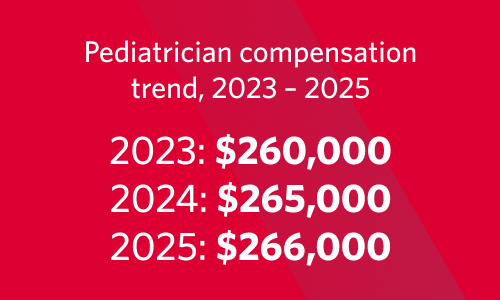
That gap isn't new, and it isn't closing. Pediatricians reported average total compensation of $260,000 in 2023, $265,000 in 2024, and $266,000 in 2025—essentially flat for three years running, even as overall physician pay rose by roughly 3% last year alone.
Pediatrics also tied with rheumatology for the flattest year-over-year change of any specialty Medscape tracked in 2025, a distinction that puts it at the opposite end of the list from specialties like cardiology (+10%), ophthalmology (+9%), and radiology (+9%).
Why pediatrician pay lags—the structural driver
The gap isn't about pediatricians failing to ask for more. Roughly 40% of pediatric patients nationally are covered by Medicaid, which reimburses at lower rates than Medicare or commercial insurance. That payer mix caps earning potential in a way largely outside any individual pediatrician's control, no matter how the negotiations go.
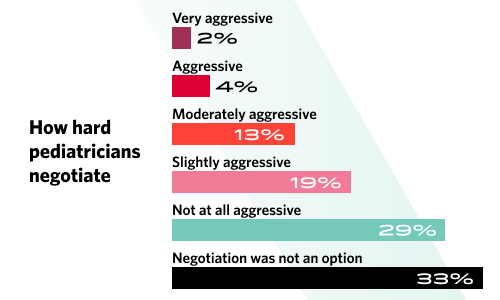
And for many pediatricians, there's little room for negotiation. In Medscape's survey, 61% of pediatricians said they didn't get more than "moderately" aggressive the last time they negotiated their contract, and 33% said negotiation wasn't an option at all.
The satisfaction paradox
Only 45% of pediatricians said they felt fairly compensated for their own work, up from 39% the year before, then the most dispirited response Medscape had recorded in 10 years of asking the question. Zoom out, and 60% of pediatricians believe doctors are generally underpaid in the U.S.
Fairness in compensation can be influenced by so many different factors that are unique to that provider or medical group. If there are staffing issues at your employer, it can affect whether you feel fairly compensated, even though that doesn't directly involve the comp structure.
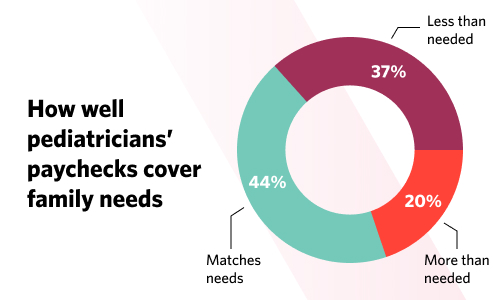
That tension—a specialty pediatricians often describe as personally rewarding, paired with a paycheck near the bottom of the field—shows up in the numbers on day-to-day financial strain, too. Only 20% of pediatricians said their pay covers more than their family's needs; 44% said it matches what they need, and 37% said it falls short.
What's the hourly wage for a pediatrician?
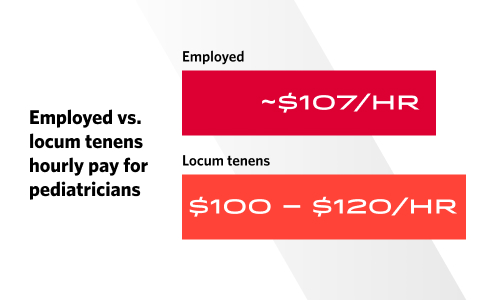
For employed general pediatricians, the Bureau of Labor Statistics reports a national mean hourly wage of roughly $107 (as of May 2025). Actual pay varies by state, setting, and patient mix, but it's a useful baseline for comparing what a locum tenens assignment could add.
Many pediatricians supplement their income with outside work
A below-average specialty salary doesn't leave much room to shrug off the gap, and plenty of pediatricians aren't trying to. Thirty-seven percent of pediatricians told Medscape they take on paid work outside their regular hours, about the same share as last year, though slightly below the 39 – 40% reported by primary care physicians and specialists generally.
Incentive bonuses tell a similar story. The average pediatrician bonus was $27,000 in 2025 (down from $29,000 the year before). Pediatricians also reported working an average of 46 hours a week, three hours fewer than physicians generally, leaving some room for additional work for those who want it.
What locum tenens pediatricians actually earn
Locum tenens work—temporary assignments that fill staffing gaps and maintain patient care—is one of the more direct, quantifiable ways pediatricians can add income without waiting on a reimbursement structure that's largely outside their control.
Locum tenens work for pediatricians pays $100-$120 per hour according to Locumstory's trends by specialty tool, depending on factors such as location, demand, shift type, and workload.
I never once earned less money than I made in full-time. It was equal, then it was more, and it's never been less, so I absolutely never shy away from that point, that if a pediatrician can do it, there is absolutely no excuse that any physician of any specialty could do it, too.
Dr. Lawrence-Reid also points to something a straight hourly-rate comparison misses: control over the terms themselves.
Things I enjoy about locums: the autonomy, the freedom, the control, the fact that things are negotiable. And as such, able to negotiate high salaries and high rates. I really enjoy that.
That distinction matters for a specialty where, as the negotiation data above shows, a third of pediatricians don't get any say over their pay at all in a traditional employment contract.
Pediatrician locum tenens pay by career stage
Where locums fits best often depends on where you are in your career—and for pediatricians, the math looks a little different at each stage than it does for higher-paid specialties.

Early career: A tougher training-cost-to-income ratio
Pediatrics carries one of the weakest training-cost-to-income ratios in medicine: three years of residency (longer with fellowship for subspecialists), set against a specialty-average income of $266,000, well below the roughly $246,000 in average medical school debt many physicians carry into practice. For early-career pediatricians, that combination makes debt payoff feel more urgent than it does in faster-growing or higher-paid specialties.
For pediatricians picking up locum tenens assignments during residency, fellowship, or right after boards, it can be one of the more direct ways to work against that ratio instead of waiting it out.
Mid-career: Breaking the plateau
For pediatricians further along in their careers, near-flat specialty-wide growth means the standard "give it time" answer doesn't really apply as it might elsewhere in medicine. Locums is less about needing more money in the abstract and more about having a concrete lever to pull now.
My current work was getting more and more stressful, and I just thought this might be a way to get a change of venue, plus make a little more, so I could take a little time off.
Variable income takes some adjustment, too, particularly for pediatricians used to a predictable paycheck.

You have to be able to budget your money because there'll be months that vary. I worked for a little while, made some money, and then went to Peru.
For Dr. Kalra, the appeal isn't just the pay; it's getting back to the parts of the job that drew her to medicine in the first place.
I keep doing it because I like that my main job is to do medicine. I come in, I see the kids, and I send them on their way. I don't have to deal with any administrative duties or inner politics between people getting along.
Late career: Easing into retirement on your own terms
Pediatricians approaching retirement are supplementing savings that compound off a lower baseline after a full career at below-average specialty pay. Locums lets you keep practicing and keep earning without the demanding full-time schedule, on a timeline you control.
That's the reason stuff like locums is so important—if you want to make sure that you can still keep your pulse, your hand on the pulse of practicing medicine, but you have to do it in a way that makes room and space for all these other things. It's really nice. And I don't feel less of a doctor.
A note for pediatric subspecialists
Pediatric cardiologists, neonatologists, critical care physicians, and other subspecialists earn meaningfully more than the general outpatient average, driving the $266,000 figure above, and the pay gap doesn't look the same for them. Even so, the appeal of locums—schedule control, no non-compete, keeping clinical skills sharp between other commitments—shows up in subspecialist voices, too.
I just didn't like the call and the limitations on life. It allowed me to keep up my skills. It allowed me to take care of the sick kids that I like. Wonderful environment to work in. But I didn't have call, I didn't have nights or weekends. There was no non-compete that strangled me.
If you're a pediatric subspecialist, the general-pediatrics pay gap explored in this report is less likely to be your story—but the flexibility case for locums often still applies.
What locums income means for your taxes
Most locum tenens work comes with 1099 independent contractor status rather than a W-2, which opens up options not available to employed physicians, such as a solo 401(k) or deductions tied to your work as a contractor. It's worth understanding before your first assignment. Our locum tenens tax guide breaks down deductions and entity options in more detail.
Do the math for yourself
Curious what locum tenens could actually mean for your bottom line? Click below to find free calculators that estimate your potential locums earnings and show how much faster you could pay off your debt. It only takes a few minutes to see the numbers for yourself.
Ready to see what's possible?
Whether you're working against a tougher training-cost-to-income ratio, trying to break a mid-career plateau, or building retirement savings off a lower baseline, locum tenens is worth running the numbers on as a financial decision, not a career change.
Give us a call at 888.714.2330 to speak with a Weatherby consultant, or view today's pediatrician jobs.
Recommended Articles
Categories

Thank you,
We appreciate you contacting us. A consultant will be reaching out to you shortly to discuss this job opportunity. You can also get in touch with us directly by calling 954.618.5296.