
Physician assistant salary report 2026: What PAs are earning, and how locums pay compares
October 07, 2026
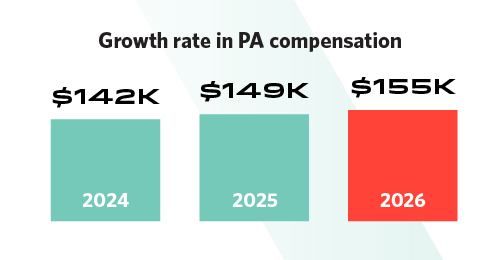
Physician assistant pay is still climbing, but it's built differently than it used to be. According to Medscape's PA Compensation Report 2026, average PA compensation reached $155,000 this year, up 20% since 2022. Base pay grew a more modest 17% over that span, from $118,000 to $138,000, while productivity pay doubled, from $5,000 to $10,000, even as bonus growth stalled. PAs are earning more, but a larger share of that pay must now be earned through performance rather than salary.
PAs feel a little better about their paychecks than they used to. Fifty-nine percent say they're paid fairly, up from 56% in Medscape's last report. That improving sentiment doesn't extend to the profession as a whole, though: 63% of PAs still say the pay disparity with physicians is too large given their contributions, versus just 2% who think it's too small. And pay was never a side consideration for most PAs in the first place. Seventy-two percent rated future income a 4 or 5 out of 5 in importance when they first decided to become a PA.
Read on for more findings from the report, plus what PAs who've tried locum tenens say about how it fits into the financial picture.
How PA pay is built differently than it used to be
The shift becomes clear once you break down where PA pay is actually coming from. Base pay has grown steadily but slowly. Productivity pay has grown much faster, starting from a smaller base. Bonus pay has moved in the opposite direction entirely: PAs averaged $4,000 in bonuses this year, down from $8,000, a 50% drop.
The most striking data point may be this: PAs paid purely on productivity or incentive, with no base salary at all, now out-earn every other pay structure, at $167,000. That's ahead of the $165,000 average for PAs on salary plus productivity pay, and further still ahead of a flat salary alone.
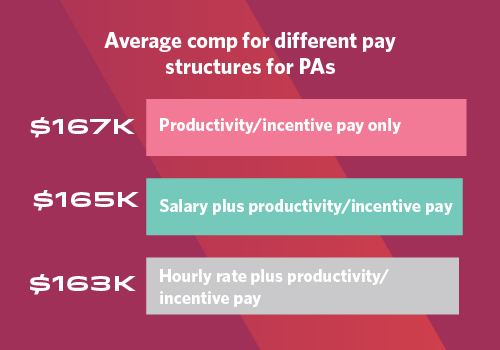
For a PA deciding how much of a new offer to negotiate as base salary versus productivity pay, or whether an hourly, productivity-driven structure like locum tenens might suit them better than a fixed salary, that's a real number to weigh.
Where you practice still shapes your paycheck
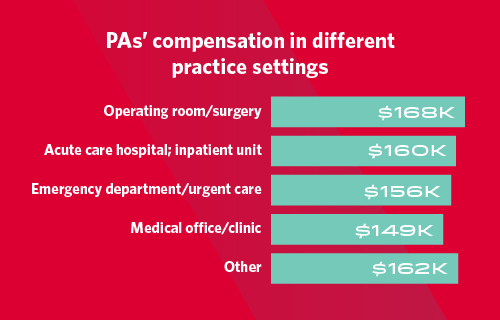
Setting still matters. Operating room and surgery settings moved to the top of Medscape's list this year, climbing 19% to $168,000, up from $141,000 in 2022. Emergency medicine crept up 15% over the same span.
Geography matters too, and increasingly so. The West continues to pull the highest PA pay in the country, climbing to $165,000 this year from $160,000 last year.
Community type has widened as well. In 2022, the spread between the highest-paying settings (exurban, at $131,000) and the lowest (rural, at $128,000) was just $3,000. This year, that spread has doubled to $6,000, with exurban settings still on top at $159,000.
Employment type shows a similar, if narrower, pattern. Hospital-employed PAs earned $160,000, up from $146,000 in 2022. Medical-group-employed PAs saw a similar jump, from $141,000 to $151,000. Hospital employment still pays more, but the gap between the two isn't widening much.
How locum tenens fits into a PA's financial picture
This is where locum tenens work enters the picture, not as a side gig, but as a direct way to act on several of these numbers at once.
Locum tenens pay is typically hourly rather than salaried, which changes the math for many PAs. “As a locum, we get paid hourly, and we actually get paid for our time,” says Diem Dang, a cardiovascular and thoracic surgery PA who's worked locum tenens since 2011, “whereas with salary, you work until it's done, and they kind of don't care how much you work.”
Hospitals and clinics also tend to pay a premium for the flexibility of bringing in a temporary provider. “Hospitals will pay a little bit of a premium for someone to come in as a temporary employee, and they will continue to pay that premium as long as you perform your duties very well,” says Lauren Whitley, a cardiothoracic surgery PA.
Locum tenens PA pay generally runs $65 to $115 an hour, according to Locumstory, with surgical and other higher-acuity specialties tending toward the higher end of that range. Actual pay varies by specialty, location, experience, and current market demand, so treat any figure as a starting point for your own research rather than a guarantee for a specific assignment.
Find out more: Why PAs love working locum tenens
Locum tenens works at any stage of a PA’s career
Locum tenens is an adaptable choice that can benefit PAs at any stage of their careers. Early on, it's often a way to test different practice settings while building income. Mid-career, it's more likely to be supplemental income or a deliberate skill-building move. And for PAs easing toward retirement, it's a way to keep practicing and earning on their own terms.
Early career: Testing the waters and building income
Carly Manchester, a cardiac critical care PA, took her first locum tenens assignment to relocate across the country before settling into a staff role. “What surprised me most about locums is the flexibility to be able to use locums as a stepping stone into a more permanent position,” she says. The assignment let her try out a new area and a new facility before committing, and it ultimately led to a supervisor role she says she likely wouldn't have had otherwise.
Lauren Whitley came to locums after a staff position ended abruptly during the pandemic. She stayed for the pay as much as the flexibility, and her advice to other early-career PAs considering it is simple: “If you're considering it, just do it.”
Discover the benefits: Locum tenens for surgical PAs
Mid-career: Two different reasons to keep going
For Diem Dang, locum tenens has become a long-term strategy rather than a phase, tied to a specific financial goal. “Locums has afforded me a lot, because it gives me a bigger income, it allows me to invest and save,” she says. “I don't have to work until I'm 65. Doing this, I don't have to.” The variety has a professional upside, too. Having worked with dozens of different surgeons, she says her skill level is “a lot better than the average PA that's been at one job for a long time.”
Stacy Hicks, a neurosurgery PA, takes a different approach, working locum tenens on the side of a full-time staff position, mostly using vacation time. “Obviously, the pay is one thing for sure,” he says, “but the biggest benefit is you get to practice and do more and see more people.” For Hicks, it's also a low-risk way to test a new opportunity: “It's almost like driving a car. You get that trial run, you get to test drive it first, because you never know, that could be your new job.”
Late career: Realizing your worth, and easing toward retirement
After 22 years as a PA, most of them at a university health system, Trina Nestor didn't take her first locum tenens assignment until fairly recently. Leaving made her reassess what she'd been settling for. “It has made me realize the value of my worth,” she says. “I was not valued at my other job. I felt like I was a number. Once I started, I realized that I'm very good at my job, and I'm needed, and I'm wanted.”
Dave Bosch, a cardiac surgery PA with about 15 years of experience, took a similar path later in his career, leaving a staff position that had grown strained. Now he's using locum tenens to control the pace of his own wind-down rather than stopping outright, cutting back from full-time work to about a quarter of that. “I plan on doing locums until I retire,” he says. “I don't ever plan on going back to a tie-down job.”
Learn more: How PAs can earn more, work less, and find balance with locum tenens
What being a W-2 employee means for your paycheck
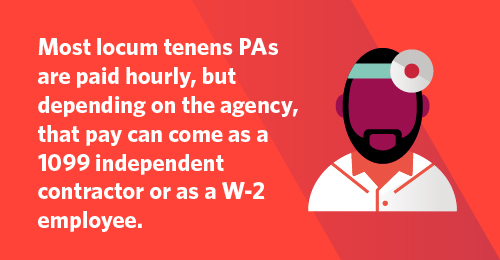
Most locum tenens PAs are paid hourly, but depending on the agency, that pay can come as a 1099 independent contractor or as a W-2 employee.
As a 1099 contractor, a PA is generally responsible for their own tax withholding, including self-employment tax, and typically has to arrange their own health coverage and retirement savings.
Weatherby Healthcare takes the other approach: PAs on Weatherby assignments are treated as W-2 employees, with taxes withheld automatically and access to the same kind of benefits package you'd expect from a staff position.
Trina Nestor rolled her 401(k) over from a previous employer into Weatherby's plan, which matches 50% of the first 8% you contribute. “I have medical, vision, dental, all of the things,” she says. “It's a pretty good plan.” Lauren Whitley describes a similar experience: “I had health insurance and a 401(k) investment option. I felt like I was just a full-time employee that had the opportunity to go to other hospitals and perform and learn.”
A tax advisor, financial planner, or CPA can help you understand how a specific pay structure affects your own take-home income and retirement planning. This article is provided for general information only and isn't a substitute for individualized professional advice.
Ready to get started? Explore today's PA locum tenens opportunities, or give us a call at 954.343.3050 to speak with a consultant.
Recommended Articles
Categories

Thank you,
We appreciate you contacting us. A consultant will be reaching out to you shortly to discuss this job opportunity. You can also get in touch with us directly by calling 954.618.5296.