
W‑2 vs 1099 for locum clinicians: Which path fits your situation?
December 01, 2025
If you’ve ever discussed taxes with fellow locum professionals, you’ve likely heard strong opinions about working as a W‑2 employee versus a 1099 independent contractor. The truth is: There’s no one-size-fits-all answer.
In more than 20 years of working with traveling medical professionals, I’ve seen both paths succeed. Some providers do best with a W-2 arrangement that includes automatic withholding, simpler filing, and access to group benefits, while others prefer the autonomy and control of 1099 work. The key is choosing the structure that fits your financial and professional goals right now.
Here’s how to decide if a W-2 or 1099 situation is best for you as a locum clinician.
Start with your situation (not a verdict)
Before jumping to conclusions, ask yourself:

Do you value simplicity and steady cash flow?
The W‑2 model may be your best bet. Taxes are withheld automatically, filing is typically simpler, and you often gain access to employer-sponsored benefits and payroll deductions. If you’re W‑2 only, see: How can I strategize my tax planning as a W‑2 earner?
Do you want more control and flexibility?
The 1099 route gives you autonomy over your schedule and finances. But it also requires quarterly estimated tax payments, tracking expenses, and potentially forming an entity to unlock further tax strategies.
Are you working both W‑2 and 1099 gigs this year?
Many locum providers do. What matters most is coordinating your tax planning across all income sources, especially for withholding, estimated taxes, and retirement contributions.
Tax tips for W‑2 medical professionals
If you're W‑2, you may have fewer options for tax deductions, but that doesn’t mean you're out of strategies. Here are several to consider.
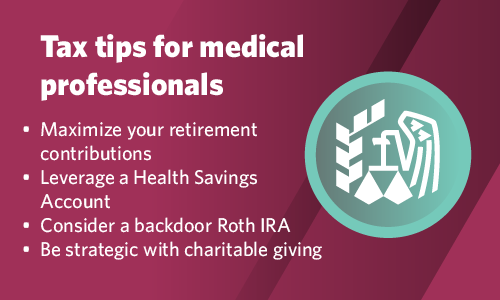
Maximize your retirement contributions
In 2025, you can defer up to $23,500 into your employer-sponsored plan. If you’re between the ages of 50 and 59 or over 64, you’re eligible for a $7,500 catch-up contribution. If you're between 60 and 63, that catch-up jumps to $11,250.
These contributions are pre-tax, lowering your taxable income, and they may qualify for employer matching, adding to your savings.
Leverage a Health Savings Account (HSA)
If you’re enrolled in a high-deductible health plan (HDHP), don’t miss out on triple tax benefits:
Pre-tax (or deductible) contributions
Tax-free investment growth
Tax-free withdrawals for qualified medical expenses
2025 limits:
Individual: $4,300
Family: $8,550
HDHP minimum deductibles: $1,650 (individual) / $3,300 (family)
Out-of-pocket max: $8,300 / $16,600
Consider a backdoor Roth IRA
High earners may not qualify to contribute directly to a Roth IRA, but a backdoor Roth is still on the table. Contribute $7,000 (non-deductible) to a traditional IRA, then convert it.
Important: To avoid pro-rata taxation, ensure you don’t have a balance in any pre-tax IRA accounts by year-end.
Be strategic with charitable giving
If you’re charitably inclined, consider setting up a Donor-Advised Fund, bunching donations into one tax year, or gifting appreciated stock. These strategies can amplify the tax impact of your giving.
Keep more of what you earn: How to maximize your savings as an NP or PA locum
Smart moves for 1099 medical professionals
As a 1099 worker, you’re essentially running your own business. That opens the door to more deductions (and responsibilities). Here are some reminders to keep things running smoothly.
Track your business expenses. You can deduct qualifying costs like licensing, CME, travel, and even a home office.
Form an entity. Depending on your income, setting up an S-corp may reduce self-employment taxes.
Open a Solo 401(k) or SEP IRA. These plans allow for larger retirement contributions: up to $70,000 in 2025 (depending on your income).
Estimate quarterly taxes. Avoid penalties and interest by paying as you go.
Advanced tax strategies for W‑2 or 1099 locum clinicians
Regardless of your employment model, there are two higher-level tax strategies worth exploring.
Real estate investments. Want to offset income with real estate losses? Make sure you understand the passive activity rules, real estate professional status (REPS), and short-term rental tax loopholes. These are powerful tools, but the IRS sets strict requirements.
Oil and gas programs. Some oil and gas investments offer immediate deductions through intangible drilling costs. Be sure to vet the risks and timelines and choose sponsors with strong track records.
Find what’s best for your situation
Instead of asking, "Which is better: W‑2 or 1099?" ask: “Which model best supports my goals this year?”
W‑2 locums work offers predictability and benefits. A well-run 1099 practice gives you flexibility and business-level tax strategies. Many clinicians blend both; just make sure your tax strategy does too.
Are you interested in learning more about locum tenens as a career alternative? Give us a call at 954.343.3050 or view today’s locum tenens job opportunities.
Recommended Articles
Categories

Thank you,
We appreciate you contacting us. A consultant will be reaching out to you shortly to discuss this job opportunity. You can also get in touch with us directly by calling 954.618.5296.