
General surgeon salary report 2026: Where pay stands and how to increase your income
September 09, 2026
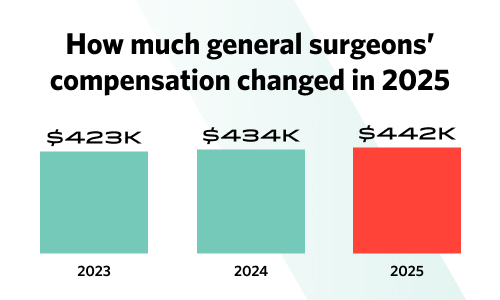
General surgeons averaged $442,000 in total compensation in 2025, according to Medscape's 2026 General Surgeon Compensation Report, an increase of about 2% from the year before, the slowest pay growth among the surgical specialties Medscape tracked this year.
That modest growth lines up with how general surgeons say they feel about their pay. Just over half, 51%, say they personally feel fairly paid, while 65% believe the medical profession as a whole is underpaid. General surgeons also reported working an average of 55 hours a week, more than the 49-hour average reported by physicians generally.
Read on for more findings from the report as well as suggestions for how to increase or supplement your general surgery pay.
How much do general surgeons make compared to all surgeons?
That $442,000 average, which includes base salary, incentive bonuses, and other income such as profit-sharing, puts general surgery 12th among the 29 specialties Medscape surveyed. Eight specialties broke $500,000 in average total compensation last year; general surgery wasn't one of them.
General surgery's 2% pay growth also wasn't an outlier on its own. Plastic surgery grew at the same rate, and nine specialties overall reported flat or declining pay this year, compared with seven the year before. Every other surgical specialty Medscape tracked, though, grew somewhere between 3% and 10%.
General surgeon income vs. other surgical specialties
Medscape's specialty rankings put the gap in concrete terms. Orthopedic surgeons average $611,000. Plastic surgeons average $554,000. Otolaryngologists average $508,000. General surgeons average $442,000, lower than every other surgical specialty in the report.
However a surgeon wants to measure it—training length, hours, or procedural demands—general surgery's pay doesn't always track with what other surgical specialties earn for comparable effort.
How general surgeons feel about their pay
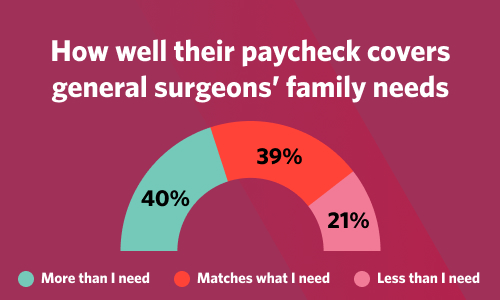
Medscape asked general surgeons directly whether they feel fairly compensated. Only 51% said yes. Asked whether their pay covers their family's financial needs, 40% said it covers more than enough, 39% said it matches their needs, and 21% said it falls short.
Negotiating toward a better number isn't straightforward, either. 65% of general surgeons said they didn't get more than moderately aggressive the last time they negotiated a contract, and 26% said they had no opportunity to negotiate at all.
General surgeon Dr. Steven Berman's own experience tracks with that data. When a rural North Carolina hospital where he'd been working as a locum offered him a staff position, there wasn't much room to negotiate.
“In an environment like theirs, there's not a tremendous amount of volume,” he says. “So there's not a lot of give and take in terms of what they can offer.” In a low-volume, rural setting, there's often a hard ceiling on what a hospital can offer, no matter how the conversation goes.
How general surgeons are trying to close the compensation gap
Medscape's data show some room to increase pay for general surgeons, though not much.
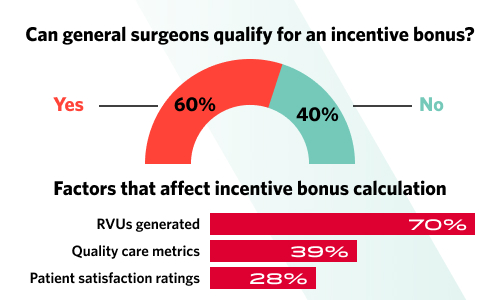
Sixty percent of general surgeons say they can qualify for an incentive bonus. Among that group, the biggest factors determining the size of the bonus are RVUs generated (cited by 70%), quality-of-care metrics (39%), and patient satisfaction ratings (28%). Beyond bonus structures, 43% of general surgeons now have base pay directly influenced by measures like RVUs, up from 41% the year before.
These options can add money to a general surgeon’s bank account. But they're calculated against a base that's already near the bottom of the surgical pay scale. A bonus tied to RVU volume can't turn general surgery into a $500,000-plus specialty on its own.
Locum tenens can augment general surgery salaries
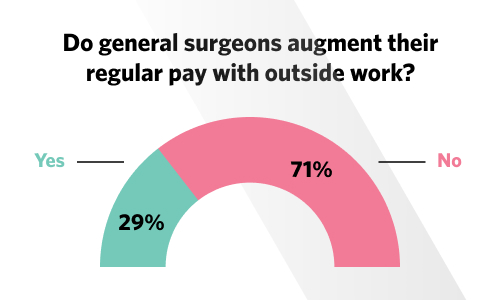
Nearly a third of general surgeons (29%) report supplementing their pay with outside work, compared with 40% of physicians overall. One option that allows surgeons to continue working in medicine is locum tenens. These temporary assignments can measurably increase compensation with just a weekend of additional work per month.
Locum tenens pay for general surgeons typically runs $150 to $200 per hour, according to data from Locumstory.com. Unlike some other specialties, general surgery locums pay is usually structured as a day or call-block rate rather than a straight hourly wage. That reflects how general surgery and trauma coverage tends to work: a flat rate for a shift or call block, with an hourly rate for any callback work on top.
For a general surgeon weighing whether a locum assignment or two might make more financial sense than another year on the same contract, that's the number worth running against a current salary.
Interested in learning more? Why locums makes sense for general surgeons
What this looks like by career stage
Locum tenens can be an option for general surgeons at any point in their career. Whether it’s paying down student debt or easing into retirement, temporary assignments are a flexible way to take control of your finances and work schedule.
Early career: Paying down debt and trying out practice settings
For general surgeons just finishing residency, the calculus looks different from that for someone 20 years into practice. Between the cost of medical school and general surgery's relatively modest starting pay, a locum tenens assignment or two can add meaningful income during exactly the years when debt payments are heaviest.
Locum tenens work also lets a new general surgeon test different practice settings before committing to one. Rural hospitals, community facilities, and large academic centers each present a different day-to-day reality, and it's easier to determine which one fits before signing a multi-year contract with just one facility.
How to pay off med school debt: A comprehensive guide
Mid-career: Two different reasons to start
For Dr. Ellen Pellegrini, the decision came down to family. After 15 years of building a trauma and acute care surgery service at a rural Maine hospital, she found herself trying to care for aging parents in Alaska while working a schedule that wouldn't flex. “I need way more flexibility,” she told her hospital. They told her she could work full time or not at all. She left.
Pellegrini eventually settled into a hybrid arrangement: a half-time staff position as a general surgeon in Bangor, Maine, paired with locum tenens trauma and critical care assignments around the country. “I have my home, my partners, my small hospital, and then fulfill my trauma critical care passion plus offer hospitals help when they've got an acute need,” she says. The arrangement maintains an income floor through her permanent role while adding locums income and flexibility on top.
For Dr. Mustafa Kabeer, a fully employed pediatric general surgeon in Orange County who performs 500 to 600 operations a year, the motivation looks different. Kabeer takes on two or three locum assignments a year, not out of financial need, but to stay adaptable and see how other institutions operate. He treats those handful of assignments as a way to keep his skills sharp and preserve flexibility for later in his career, even while fully committed to a demanding full-time practice now.
Locum tenens helps you explore what other places are like.
Late career: Retirement transition
For Berman, locum tenens has become a way to keep practicing general surgery on his own terms as he approaches retirement. “For me, locums has been a reasonable bridge from being a full-time practicing surgeon to retirement,” he says.
The financial rationale for that bridge is specific to the pay structure of general surgery. Because staff positions in this specialty already sit near the bottom of the surgical pay scale and there's often little room to negotiate a better staff rate late in a career, working locum tenens can pay more per day than continuing in an employed role. For a general surgeon winding down toward retirement, that can mean earning more while working fewer weeks a year, rather than staying on a fixed schedule at a rate that was already limited to begin with.
Making a retirement decision soon? Why using locums to transition makes sense
Tax and 1099 considerations for general surgeons
For physicians considering locum tenens, many want to know what changes when income is reported on a 1099 instead of a W-2.
As an independent contractor, a locum tenens physician is generally responsible for their own tax withholding and can deduct business expenses that a W-2 employee typically can't deduct, including travel, licensing, and certain home office or equipment costs.
Some physicians who take on a substantial amount of 1099 income choose to structure that work through an S-corporation rather than a sole proprietorship, which can change how the income is taxed and how much is subject to self-employment tax.
This is general information, not individualized tax or legal advice. Tax treatment varies by state, income level, and business structure, and the right approach for one physician may not be the right approach for another. Any general surgeon considering a shift toward 1099 income should talk with a CPA or tax advisor familiar with physician finances.
Tips for managing locums income: The finances of locum tenens
Do the math for yourself
Curious what locum tenens could actually mean for your bottom line? Click below to find free calculators that estimate your potential locums earnings and show how much faster you could pay off your debt. It only takes a few minutes to see the numbers for yourself.
Locum tenens can help increase your general surgeon compensation
General surgery's pay hasn't kept pace with the rest of surgery, and for many general surgeons, there isn't much room to change that from inside a single staff position. Locum tenens work is one of the more direct, documented ways general surgeons at every career stage have found to change the number instead of waiting for it to catch up.
Give us a call at 954.343.3050 to speak with a consultant or click below to view today's general surgery locum tenens job opportunities.
Recommended Articles
Categories

Thank you,
We appreciate you contacting us. A consultant will be reaching out to you shortly to discuss this job opportunity. You can also get in touch with us directly by calling 954.618.5296.