
Neurology salary report 2026: How much do neurologists make?
September 02, 2026
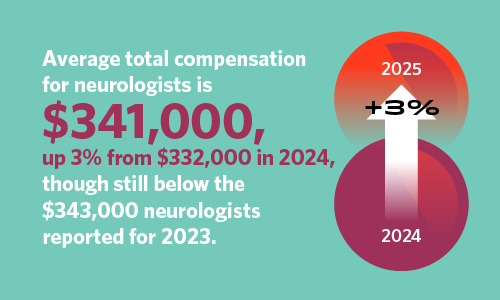
If you're a neurologist, there's a good chance you've wondered how your pay compares to the rest of the field, or what it would take to earn more. The average neurologist earned $341,000 in 2025, according to Medscape's Neurologist Compensation Report 2026—up 3% from $332,000 in 2024, though still a bit below the $343,000 neurologists reported for 2023. That's a more modest spot on the pay scale than some specialties occupy, but the more interesting question isn't where neurology ranks against orthopedics or cardiology. It's what that pay could be doing for you right now, and whether locum tenens could put your earnings to work faster. Here's what the data says, along with what one neurologist who's added locums to her career has to say about her own numbers.
Neurologist salary: National average and range
At $341,000, the average neurologist salary sits well below the $386,000 average across all physicians and the $417,000 average for specialists, according to Medscape's companion Physician Compensation Report 2026.

Neurology isn't among the eight specialties that cleared $500,000 in average pay last year—orthopedics ($611,000), cardiology ($575,000), and radiology ($571,000) lead that list. Instead, neurology's $341,000 average lands in the middle of the field: just below nephrology and physical medicine & rehabilitation (both $359,000), just above psychiatry ($331,000), and well ahead of family medicine ($288,000) and pediatrics ($266,000), which round out the bottom.
Pay also varies by subspecialty. Per the AAN's 2025 Neurology Compensation and Productivity Report (2024 practice data)—a different source from the Medscape specialty comparison above:
Vascular neurology/stroke: $315,913 (highest subspecialty)
General neurology: $309,882
Epilepsy: $282,386
Child/pediatric neurology: $256,082 (lowest, despite the added fellowship training it requires)

For a neurologist, that's a fine position on the pay scale, not a flashy one. Keep reading to find out what locum tenens could add to it.
What is locum tenens? Locums beginner's guide
Why neurologist pay is holding steady
Neurologists' sentiment about pay improved sharply in the 2026 survey: 58% of neurologists said they feel fairly compensated individually, up from 45% the year before, one of the largest year-over-year jumps in the survey. Fewer neurologists think the profession generally is underpaid, too (52%, down from 61%).
Demand is part of the story. Dr. Asia Filatov, a neurohospitalist, points to a workforce shortage that puts neurologists in the position of being the deciding voice on care that can't wait:
There are 15,000 neurologists nationwide, and because of the shortage, we are in high demand.
"I think we are supplementing those rural areas. The nearest stroke center may be 100 miles away," Dr. Filatov says. "So, at least the initial executive decisions are imperative to have at least someone who is there."
That demand hasn't translated into runaway growth, though. Neurologist pay grew about 3% in 2025—roughly matching the average increase reported across primary care and specialist physicians, and ahead of the year's 2.7% core inflation rate, but well behind the specialties seeing the fastest growth, like cardiology (10%) and radiology (9%). Private-practice neurologists in particular may be feeling the pinch of flat Medicare reimbursement rates against rising costs.
What's the hourly wage for a neurologist?
For an employed neurologist, hourly pay averages about $129 an hour nationally, according to the Bureau of Labor Statistics—though it varies widely by state, from roughly $94 an hour in California to more than $200 an hour in higher-demand markets like Indiana. Actual pay varies by person, but this gives a general sense of what staff neurologists earn per hour.
Many neurologists supplement their income with outside work
A modest, steady salary doesn't always feel like the whole picture, and neurologists aren't the only ones looking for ways to add to it. In the 2026 survey, 47% of neurologists said they've found time to take on paid work outside their regular hours—up from 38% the year before, and notably higher than the 40% reported by physicians generally.

That extra work takes different forms, from picking up more hours to non-medical side work. But for a growing number of neurologists, it means locum tenens.
What locum tenens neurologists actually earn
Locum tenens work—temporary assignments that fill staffing gaps and maintain patient care—can be a great way to increase your income as a neurologist.
Locum tenens pay for neurologists currently ranges from $225 to $325 per hour, according to Locumstory's trends data. That's a meaningful increase over the roughly $129-an-hour average for employed neurologists. Where you land in that range depends on a few things: location, practice setting, your experience, and whether the assignment includes call. Pay can vary quite a bit from one assignment to the next, so think of that range as a starting point for a conversation with a consultant, not a guarantee.
There is the perception of lack of accountability. You just do what you're told, and you leave. A lot of us don't view it that way. I feel like we are supplementing a gap or a need where there's a significant shortage, specifically in neurology.
Set that next to the hourly figures above, and the gap starts to explain why neurologists—in a specialty already stretched thin by a workforce shortage—are taking a second look at locums, not as a replacement for their career, but as a way to add to it.
Find out: What it's like working as a locum tenens neurologist
Neurologist locum tenens pay by career stage
Where locums fits best often depends on where you are in your career.

Early career: Dr. Asia Filatov
Dr. Asia Filatov went straight into locum tenens work a week after graduating from residency, while searching for a permanent position. "It provided me with autonomy, flexibility, variety in work environments, which was very helpful for somebody who's a new grad and doesn't know the trajectory of their career... versus what my future goals will encompass," she says.
I had a goal in mind when I finished my residency, and I'm going to give myself a certain amount of time to pay my student debt off. And I was able to do that with locums. I was probably a little over half a million dollars worth of debt, and locums was very helpful in pretty much eliminating that.
She's direct about the trade-off, too: "You don't have health insurance, or you don't have your 401(k)s or the things that come with a steady, stable job... but then you're giving up one thing for another, which is the flexibility, the autonomy." That trade-off is the natural entry point into the tax and retirement-planning considerations below.
Mid-career: Increase your work-life balance
For neurologists further into their careers, the appeal of locums often has less to do with needing more money and more to do with wanting more say over how and when you work—choosing assignments, settings, and schedules that fit the life they've already built, rather than the one dictated by a single employer.
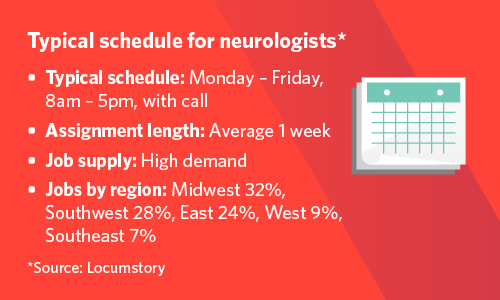
Learn more: How locums jobs help you achieve a better work-life balance
Late career: Ease into retirement
Neurologists approaching retirement use locums to keep practicing without a full-time workload—working fewer hours while maintaining their license, or choosing assignments in places they'd like to spend time.
Physician retirement strategy: Supplement your income with locums
What locums income means for your taxes
Most locum tenens work comes with 1099 independent contractor status rather than a W-2—the trade-off Dr. Filatov names directly when she talks about giving up employer-sponsored health insurance and a 401(k). That status also opens planning opportunities most employed physicians don't have, such as solo 401(k) contributions and deductions for business expenses, alongside new responsibilities like paying estimated taxes quarterly.
This is general information, not tax or financial advice. Talk with a qualified tax professional or financial planner about what these options could mean for you.
Have questions about locums income? Read The finances of locum tenens
Do the math for yourself
Curious what locum tenens could actually mean for your bottom line? Click below to find free calculators that estimate your potential locums earnings and show how much faster you could pay off your debt. It only takes a few minutes to see the numbers for yourself.
Ready to see what's possible?
Whether you're paying off medical school debt, building toward retirement, or just looking for more control over your schedule without giving up income, locum tenens is worth running the numbers on.
Give us a call at 954.343.3050 to speak with a Weatherby consultant, or view today's neurology locum tenens opportunities.
Recommended Articles
Categories

Thank you,
We appreciate you contacting us. A consultant will be reaching out to you shortly to discuss this job opportunity. You can also get in touch with us directly by calling 954.618.5296.