
Tips for your next locum tenens assignment
September 21, 2026
After finishing your first locum tenens assignment, it’s time to get ready for your next one. And this time, you can use all the knowledge you’ve gained from your first assignment to be better prepared for the next one. Here are six practical tips for preparing for your next locum tenens assignment.
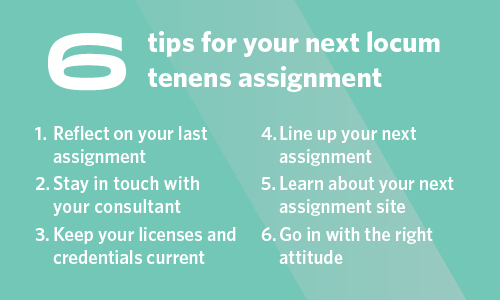
1. Reflect on your last assignment while it’s still fresh
If you’ve just finished your assignment, write down how the assignment actually went, including what worked, what you would change, and whether you would go back.
Dr. Marsha Peart, a family medicine physician, likes to pay attention to how she was treated. “How do the nurses and the support staff and the providers, how does everyone get along?” she asks. This kind of information can be tricky to determine before you start an assignment, and it’s what she weighs when she’s deciding whether to extend a contract.
Send your notes to your consultant while they are still specific. Knowing what you thought of the assignment and the work environment, and what you liked and disliked, will help them place you in another assignment that fits your needs.
2. Stay in touch with your consultant
Your consultant can best help you find your next assignment by receiving up-to-date information about your schedule, needs, and preferences. That way, they’ll have you in mind when the right assignment comes across their desk.
Dr. Nicholas King, a neurologist, has worked with Weatherby Healthcare for 13 years. “The most important thing that has kept me with Weatherby is my consultant,” he says. He’s worked with Justin for a little over 10 years, long enough that they now know each other’s families, though they have yet to meet in person.
What he values is a consultant who understands that a locum physician has a life outside of work, and that they’re someone who follows through. Of his consultants, past and present, Dr. King says when he emails Justin, he knows he’ll get a response.
Use the downtime to bring your consultant up to date. Tell them when you’re available, if anything has changed about the work you want, if there is time off you’re protecting, as well as any preferences that have shifted. For example, Dr. King's own criteria have changed: “As I get older, my tolerance for taking call has decreased quite a bit,” he says, “so I'm now preferencing assignments where there's no call.”
3. Keep your licenses and credentials current
Keeping your paperwork, licenses, and other certifications up to date ensures you’ll be ready to go when the next opportunity arises. It’s worthwhile to take a look at:
State licenses and their renewal dates
Your Interstate Medical Licensure Compact letter of qualification, if you qualify
DEA registrations, state by state
Board certification, BLS, ACLS, and PALS
Immunization records and references
The Interstate Medical Licensure Compact is worth watching, too. It now covers more than 40 states and territories, making licensing in a new state considerably more straightforward for eligible physicians.
Even physicians who’ve done this many times still find things they haven’t seen before. “Even though I've been through credentialing more than a dozen times, there are still things I don't understand,” Dr. King says. Requirements vary by state, specialty, and circumstance, so ask. Your consultant or Weatherby’s credentialing team would rather explain something than have it hold up an assignment.
4. Line up your next assignment
This is where experience pays off. After working your first assignment, you know things about your own preferences that no amount of research would have told you at the start. Dr. King says, “I didn't know enough about locums to know what I liked and what I didn't like and what was important to me.” It took a couple of years of different assignments before he could rank the two or three things that mattered most.
For Dr. King, those are inpatient neurology, a particular EMR, and travel that doesn’t consume a day in each direction. If an assignment fails one of the three, he will pass on it, even when everything else looks good.
Dr. Peart's approach is to be clear about “what you're willing to do and what you're looking for,” and make sure the answers you get back confirm that you will be “stepping into the preferred situation.”
Here are some items worth asking before you say yes to your next assignment:
What kind of facility it is, and which procedures are handled in-house rather than transferred out
How many patients a day, and how the scope of practice compares with your skill set
The nursing-staff-to-provider ratio
Which EMR is used, if you will be learning it on-site, and whether there is remote access
The hours, and how call is structured
Total door-to-door travel time rather than distance.
What the neighborhood is like, and whether your housing includes the amenities you require.
5. Learn about your next assignment site in advance
Now that you understand what a locum assignment is like, it’s easier to start off the next assignment on the right foot. Learning about the facility in advance and understanding which information will be useful is key.
The most useful thing Dr. King does before an assignment is to ask to speak with someone he’ll actually be working with. “Weatherby does a really good job, at least with me they have, of connecting me with those people ahead of time,” he says. He asks specifically for a provider, “not an administrator, but an actual provider at that hospital.”
At the most recent hospital where he worked, the service was busy from the first hour, with almost no orientation. Because he’d already spoken to a colleague, he already knew what he was walking into and was able to get started immediately.
What Dr. King doesn’t do is homework on the facility itself. “I don't even go to the hospital website, because that's what they want to publicize,” he says. “You're not going to get behind the scenes. You're not going to get to see what it's really like working at that hospital.”
Want more tips for locum assignments? Read about preparing for your first locum tenens assignment.
6. Go in with the right attitude
After 13 years of walking into other people's departments, Dr. King has noticed that when a hospital is unhappy with a locum physician, the complaint is rarely clinical. “Rarely do I hear, oh, he's just not any good at being a neurologist,” he says. “Typically it's, he's a jerk, or she's mean. It's the personal stuff.”
His conclusion is to treat the place as somebody else's. “Recognize that you are a guest in their house,” he says. “You’re getting into a system where they've been practicing just fine without you for years and years. They have their ways, they have their culture. Try to fit in.”
Dr. Peart's advice for the first week is to “give yourself grace, especially with the EMR.” Every office is different, she points out, even when the medicine is the same, so walking into something unfamiliar is less about knowing everything than knowing where to find what you need. And if a fit turns out to be wrong, an assignment “is as temporary as you need or want it to be.”
Frequently asked questions
What should I do after a locum tenens assignment ends?
Submit your timesheet, hand off your patient list, and let the facility team know you’re leaving. Then write down what worked, what you would change, and share it with your consultant. That feedback helps ensure your next assignment is the right fit.
Should I work with more than one locum tenens agency?
Many physicians do, and it can widen the range of assignments you’re offered. The trade-off is depth. A consultant who has worked with you for years knows your preferences well enough to filter opportunities before they reach you.
How often should I talk to my consultant?
There is no set rhythm. Be sure to reach out if you have a change in availability, assignment preferences, or other circumstances that may affect placement. It’s also helpful to be in touch routinely to ensure you don’t miss out on assignments that might be the right fit.
How long can I go between locum tenens assignments?
That is largely up to you, and some physicians deliberately take long gaps. Some practical constraints are keeping licenses and credentials current, since letting them lapse adds work later.
Are you between assignments? Give us a call at 954.343.3050 to talk with your consultant or view today’s locum tenens job opportunities.
Recommended Articles
Categories

Thank you,
We appreciate you contacting us. A consultant will be reaching out to you shortly to discuss this job opportunity. You can also get in touch with us directly by calling 954.618.5296.