
Psychiatrist salary in 2026: Why pay dipped and how to earn more
August 25, 2026
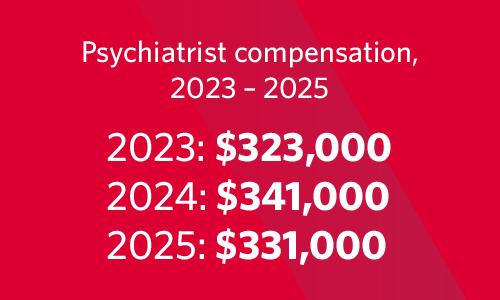
Psychiatry is one of the hardest specialties in medicine to recruit for right now; searches take longer to fill than in almost any other area of primary care, the workforce is aging, and demand for mental healthcare keeps climbing. So it's a little jarring that, in the same year, psychiatrists' pay went in the wrong direction. According to Medscape's 2026 Psychiatrist Compensation Report, average total compensation fell to $331,000 in 2025, down about 3% from $341,000 the year before. It's one of only two specialties, alongside allergy and immunology, to post a real decline this year, while physician pay generally rose about 3%.
Where psychiatrists' pay stands in 2026
According to Medscape's 2025 survey of more than 5,900 physicians, the topline figure is $331K in average total compensation. That's down from $341K in 2024, but still above the $323K reported for 2023—so the three-year picture is more of a bumpy plateau than a straight decline.
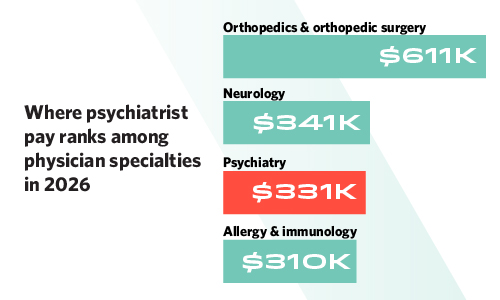
For context, psychiatry sits in the middle of Medscape's 29-specialty ranking—just behind neurology ($341K) and just ahead of allergy and immunology ($310K), a long way from orthopedics at the top ($611K) but also well ahead of the lowest-paid specialties like pediatrics ($266K).
Why the dip happened
A few things in Medscape's data help explain the dip in compensation, even if no single factor accounts for it all.
Psychiatrists' pay relies less on productivity bonuses than that of some specialties. Only 44% of psychiatrists in the survey qualified for an incentive bonus, and among those who did, the average bonus was $32,000. Just 21% said that quantifiable metrics like relative value units (RVUs) directly affect their base salary—for most psychiatrists, pay is comparatively fixed rather than tied to volume. That cuts both ways: it's more predictable in a good year, but it also means that if things slow down, you can't easily fix it by ramping up productivity.
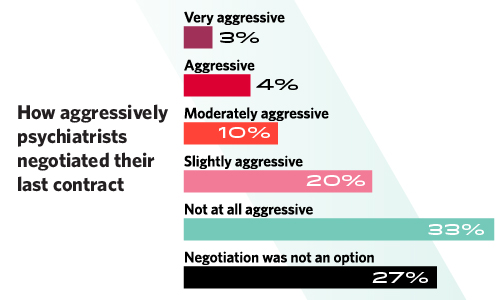
Negotiating leverage is also limited. Sixty-three percent of psychiatrists said they didn't get more than "moderately aggressive" the last time they negotiated a contract. That's consistent with what compensation consultants describe elsewhere in the report. More employers are standardizing pay philosophies rather than negotiating doctor-by-doctor, which limits how much an individual physician can move the number, regardless of specialty demand.
None of this means psychiatrists are doing anything wrong. It means the pay dip is largely structural—tied to how compensation is built, not to how hard any psychiatrist pushed, asking for more.
Webinar recap: How to negotiate a better contract
The satisfaction paradox
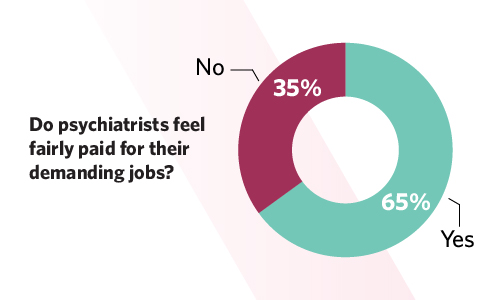
Here's the part of the data that doesn't fit a simple "psychiatry is underpaid" narrative: 65% of psychiatrists say they personally feel fairly compensated, a share that held steady from last year, and notably higher than physicians overall. At the same time, 56% believe the medical profession generally is underpaid.
That's not really a contradiction. As noted in an AMGA report, how fairly paid someone feels is shaped by much more than the number on the check—staffing levels, workload, and day-to-day working conditions all factor in. For psychiatry specifically, that context includes a documented workforce shortage (specialty searches have historically taken meaningfully longer to fill than primary care ones) and a heavy documentation and workload burden. A psychiatrist can feel reasonably good about their own situation and still recognize that the field is structurally leaving money on the table.
Prevent burnout: How locums can help
How pay differs by career stage
The pay dip lands differently depending on where you are in your career—and so does the case for locum tenens as a way to change your own numbers, independent of what the specialty average does in any given year.

Early career: Debt payoff is often the immediate pressure. Dr. Chinenyenwa Onyemaechi entered locum tenens work shortly after finishing her fellowship, largely to pay off her loans faster than a standard employed timeline would allow—by 2020, she was debt free. Dr. Gregory Carr had a similar story: Locums gave him income sooner than waiting out the credentialing and hiring timeline for a permanent position would have.
Hear from locum psychiatrists: What it's like working locums out of residency
Mid-career: The lever shifts from speed to structure. Dr. Umesh Bhandari, about 12 years into practice, set up an S-Corporation and his own Solo 401(k) around his locum income—a tax-planning and retirement-diversification move that isn't tied to his specialty's average that year. Dr. Michelle Schofield, roughly two decades in, uses locums work differently: She's paid on the 15th for her primary job, and having a second, weekly locum paycheck gives her a cash-flow rhythm she's found genuinely useful, on top of the extra income itself.
The financial side of locums: Do I need a business entity to work locums?
Late career: if your income dipped this year, that matters more here than it would in a specialty with steady growth, since your retirement savings only compound off what you're actually earning. That makes the timing question feel more urgent.
Wherever you are in your career, the question underneath it all is the same: what would even a modest, predictable bump in income do to your specific plan?
Nearing retirement? Locums can help ease the transition
The locum tenens pay picture
Across specialties, locum tenens physicians earn about $32.45 per hour more on average than their employed peers, per Hanover Research and CHG data. Based on where it falls relative to the specialties that are named—anesthesiology ($359/hr), surgery ($323/hr), emergency medicine ($266/hr), and cardiology ($265/hr), against an all-specialty average of $239/hr—psychiatry likely sits in the lower tier, somewhere in the $145 – $222/hr range.
What is well documented is the demand side: The median number of active physician searches per organization roughly doubled from 53 in 2017 to 110 in 2022, and 47% of all physician searches remained unfilled at year-end 2022. Psychiatry, as a specialty care role, has historically taken longer to fill than primary care positions. That kind of sustained shortage is generally the backdrop against which locum tenens rates hold up.
This isn't an argument for leaving your job. Every physician quoted here uses locums work to test different scenarios against their own numbers: debt payoff, tax structure, cash flow, not as a full career change. And more than one made the point that the appeal isn't purely financial. Control over your own schedule and freedom from a non-compete carried real weight on their own.
Why locums? Learn why locum tenens makes sense for psychiatrists
A note on the shortage
It's worth sitting with the context of the shortage on its own for a moment, separate from the pay conversation. Psychiatry positions have historically taken significantly longer to fill than primary care roles; nearly three-quarters of organizations now use outside search firms to fill physician roles, and the existing workforce skews older. None of that resolves the pay-dip question, but it does mean this is a specialty employers are actively competing for, which is useful context to keep in mind alongside a down year in the compensation data.
Do the math for yourself
Curious what locum tenens could actually mean for your bottom line? Click below to find free calculators that estimate your potential locums earnings and show how much faster you could pay off your debt. It only takes a few minutes to see the numbers for yourself.
The bottom line
A 3% dip in one survey year doesn't say anything definitive about psychiatry, and it isn't a mark against your own negotiating. It's a single data point, in a specialty that's still genuinely hard to recruit for. The useful move is a concrete one: look at where you are in your career, and figure out what even a modest, predictable amount of extra income, whether from a bonus structure you can't control or a locum assignment you can, would actually do to your plan.
Interested in exploring locum tenens work as a way to supplement your income? Give us a call at 954.343.3050 to speak with a consultant or view today's psychiatry locum tenens job opportunities.
Recommended Articles
Categories

Thank you,
We appreciate you contacting us. A consultant will be reaching out to you shortly to discuss this job opportunity. You can also get in touch with us directly by calling 954.618.5296.