
Urology salary report 2026: What urologists earn and how to boost your pay
September 01, 2026
The average urologist salary in 2025 was $535,000, according to the Medscape Urologist Compensation Report 2026—a roughly 6% increase over 2024, and about double the approximate 3% growth most physicians saw. That places urology among the highest-earning procedural specialties in medicine, alongside anesthesiology, cardiology, and radiology.
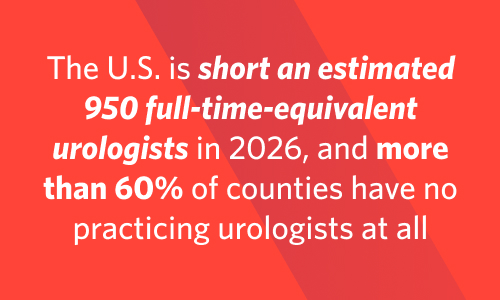
But pay isn't really the source of tension in this specialty right now. The U.S. is short an estimated 950 full-time-equivalent urologists in 2026, more than 60% of counties have no practicing urologist at all, and roughly 40% of the current workforce is retirement-eligible within the next decade. Urology's locum tenens story is less about optimizing an already-strong paycheck and more about a structural shortage that isn't going away, which is also why many urologists using locum tenens right now are doing it on their way toward, or past, a traditional retirement point rather than as an early-career stepping stone.
Read on to understand what urologist pay looks like right now, the different ways you can influence your own compensation, and how locum tenens fits into a broader financial plan at any career stage.
Where urologist pay stands in 2026
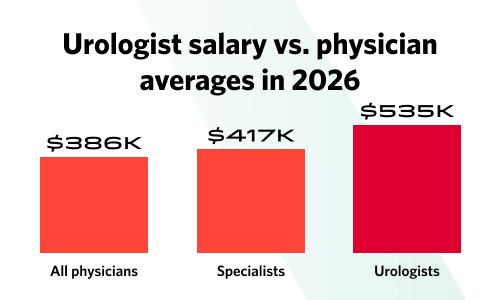
Urologist salary averaged $535,000 in 2025, up roughly 6% year over year. For context, that trails only a handful of specialties and sits well above both the $386,000 average across all physicians and the $417,000 average across specialists broadly.

The growth number tells a more optimistic story than urologists themselves report feeling. Despite an average salary of $535,000, only 49% say they feel fairly compensated individually, and 73% believe the medical profession is generally underpaid. Expectations heading into 2026 are mixed: 35% expect further pay increases, 43% expect flat pay, and 23% expect a decline.
Part of the disconnect is structural. Fifty-two percent of urologists say productivity metrics (RVUs) now influence their base pay, not just a bonus—meaning case volume and efficiency, not simply years in practice, increasingly determine where an individual urologist lands relative to the $535,000 average.
Ways to increase your compensation without changing employers
A good question to ask: what's driving your current paycheck? With 52% of urologists saying RVUs directly influence base pay, not just a bonus on top of it, knowing exactly how your employer weighs those metrics—case mix, throughput, quality scores—can be more useful than a blanket ask for more.
Practice structure matters too. Private-practice urologists who own a stake in an ambulatory surgery center report earning $700,000 to $900,000 or more, roughly $300,000 above hospital-employed colleagues performing identical procedures, according to industry compensation data—a reminder that the biggest pay lever in this specialty is sometimes structural, not just RVU volume.
Why more urologists are turning to locum tenens
For urologists who've already optimized what they can inside a current role and aren't looking to change employment models, locum tenens is a separate, more direct lever.
Locum tenens urologists are currently earning $220 – $275 per hour, according to Locumstory's pay-trends data. The typical urologist schedule is 8-hour clinic shifts with night call and 24-hour weekend coverage; assignments average one to six months, and job supply is currently rated high demand—a direct reflection of the shortage described above.

Locum tenens pay is an hourly rate, not a guaranteed annual salary. Actual earnings vary by location, practice setting, experience, and call requirements.
What the hourly number doesn't capture is how much of a permanent role's compensation gets absorbed by overhead before it ever reaches take-home pay:

Compared to my private practice, I'm making probably at least twice as much. I can work two weeks and bring home about the same amount that I was netting from private practice with half the time and a lot less of the administrative headaches.
Dr. Robert Biggers says he isn't earning more because locums pays some enormous premium; he's earning more per hour worked because locums strips out the administrative drag (committees, insurance battles, hospital politics) that was quietly eating into his private-practice take-home. That distinction—gross comp versus what you actually keep—is worth sitting with before assuming employed pay and locum pay are an apples-to-apples comparison.
Locums for urologists: Its pros and cons
Locum tenens at every stage of your career
Four urologists who've worked with Weatherby—spanning mid-career to well past a traditional retirement point—describe what locums has meant at their stage.
Early-career urologists: A near-guaranteed head start
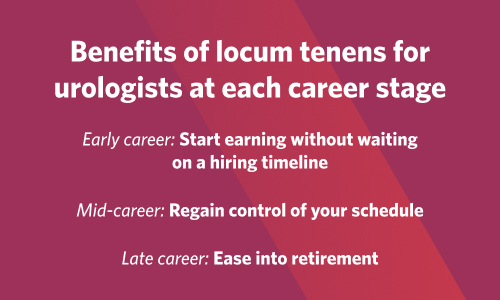
With a 950-FTE national shortage and more than 60% of U.S. counties lacking a practicing urologist, a resident or early-career urologist has near-guaranteed locums demand nationwide—a way to build broad case exposure across settings before settling into a permanent role, and to start earning without waiting out a slower hiring timeline.
Mid-career urologists: A way to renegotiate control
After 10 years in solo private practice and an unhappy stint as an employed physician, Dr. Alisa Berger's alternative to permanent work wasn't more permanent work.

If I worked full-time locums, I certainly would make more money, but that's the other benefit of locums, is that I'm basically a part-time doctor. I never got to take my kids to school or pick them up from school, but as a locum when I'm home, I can do all of that.
Dr. Berger deliberately trades some income for time; she chooses busier, higher-earning assignments when she can be away from her two kids, and lighter ones when she can't, rather than defaulting to maximum hours.
Late-career urologists: A longer runway before full retirement
Roughly 40% of the urology workforce is retirement-eligible within a decade. Among urologists planning some transition, about 70% expect a phased retirement, with 29.6% specifically planning to use locum tenens as part of it.
I lasted about six months as fully retired. It was in the early summer of 2018 that I did my first locums assignment.
Dr. Biggers retired from private practice in 2017, found retirement didn't take, and came back on locums terms instead. His practical advice for anyone starting: Expect a learning curve with licensing and credentialing when you first work in a new state. However, it's easing with the Interstate Medical Licensure Compact (IMLC).
Everyone is always wanting me to go back into full-time practice, and I just said no. It would take too much time in my day and too much of my energy.
After decades into academic urology, Dr. Theodore Ning now blends a modest number of locums and private-call days a year with mentoring residents and running nonprofit education work abroad. Money isn't the driver—flexibility to keep practicing medicine on his own terms, alongside everything else he's built a life around, is.
I kind of look at locums as sort of retirement with interruptions. You get to experience retirement without committing to retirement.
Dr. Jeffrey Miller started locums at 60 after roughly 30 years in private practice. He doesn't frame it as a bridge toward retirement so much as a way of prolonging his career on his own schedule—and his regret, that he wishes he'd started five years earlier, is worth sitting with if you're a urologist on the fence.
I think probably five years earlier would have been ideal for me to do this. I believe that I did this too late.
Geography plays into all of this, too. Locumstory's current data shows the Southwest leading urology locums demand at 32% of openings, followed by the Midwest and East (23% each), the West (16%), and the Southeast (5%).
The real cost (and reward) of independence: Taxes and 1099 structure
Locum tenens work typically means being paid as a 1099 independent contractor rather than a W-2 employee. That opens up planning opportunities most employed physicians don't have—such as solo 401(k) contributions and deductions for business expenses—alongside new responsibilities, like paying estimated taxes quarterly.
There's really not a whole lot to that in terms of day to day, month to month. You pay your quarterly taxes, the estimated quarterly. If you pay enough taxes in a given year and you can afford not to keep working, you take a little extra time off.”
For a deeper walkthrough of solo 401(k) contributions and deduction planning specific to 1099 locum income, read all about locum tenens finances.
Are you nearing retirement? Think about locum tenens
Do the math for yourself
Curious what locum tenens could actually mean for your bottom line? Click below to find free calculators that estimate your potential locums earnings and show how much faster you could pay off your debt. It only takes a few minutes to see the numbers for yourself.
Give us a call at 954.343.3050 to speak with a consultant, or view today's urology locum tenens job opportunities.
Recommended Articles
Categories

Thank you,
We appreciate you contacting us. A consultant will be reaching out to you shortly to discuss this job opportunity. You can also get in touch with us directly by calling 954.618.5296.